



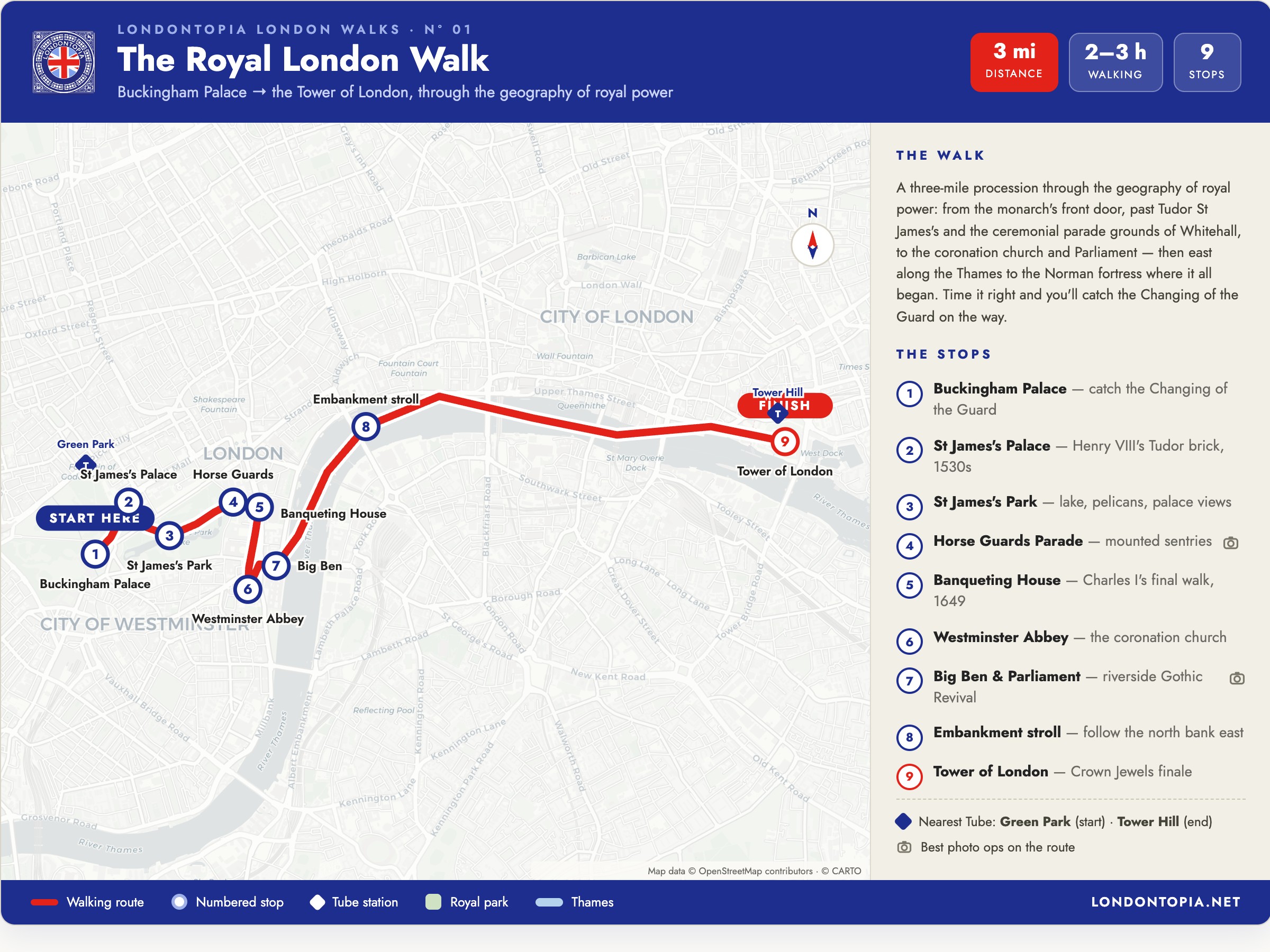
Take this walk with you: download our free, printable PDF map of the route to keep in your pocket — no phone signal required. Download the printable map (PDF) →
Royal London is one of the most visually distinctive versions of the city, a landscape of palaces, ceremonial streets, and institutions of power. This walk, beginning at Buckingham Palace and ending at the Tower of London, connects the major royal sites and takes you through the geography of power and privilege that has characterized London for centuries. The walk covers roughly three miles and takes approximately two to three hours, though with visits to attractions along the way, you can easily spend a full day.
Begin at Buckingham Palace itself, the official London residence of the British monarch. The palace, with its distinctive Portland stone façade and the Victoria Memorial in front of it, is one of the world’s most recognisable buildings. You can’t enter the palace unless you’re visiting during the brief summer months when parts of it open to the public, but the exterior and the surrounding area give you a sense of the scale and grandeur of the royal institution. The Changing of the Guard ceremony, which occurs daily (exact times vary), is one of London’s most popular tourist attractions—the ceremony, with its formal uniforms and precise military pageantry, is an extraordinary display of British ceremonial tradition.
From Buckingham Palace, walk northeast toward St James’s Palace, another major royal residence and the working palace that serves as the London home of several members of the Royal Family. St James’s Palace, dating from the 16th century and built by Henry VIII, retains a more intimate scale than Buckingham Palace despite its historical significance. The palace, with its distinctive red brick and its historic Tudor architecture, represents an older version of royal power than the grander Georgian and Victorian palaces.
St James’s Park, stretching out from the palace toward Westminster, provides a green space within the urban core and is one of London’s most pleasant parks. Walking through the park, you’ll pass the lake, the gardens, and the various memorials and monuments that commemorate aspects of British history and power. The park is beautiful and provides a welcome respite from the city’s busier streets.
Continue east, passing Horse Guards Parade, where the formal parade ground displays another aspect of British military ceremony. Horse Guards, the mounted guards who stand at the entrance to Whitehall, are among London’s most photographed ceremonial figures. The buildings surrounding Horse Guards Parade represent governmental power—these are the ceremonial and administrative spaces where the business of government is conducted.
The Banqueting House, located on Whitehall, is a stunning Renaissance building designed by Inigo Jones. The building’s most famous historical fact is its connection to the execution of Charles I, who stepped out onto the scaffold from the Banqueting House onto a scaffold erected outside the building in 1649. The building’s architectural significance as one of England’s first truly classical structures adds another dimension to its historical importance. The Banqueting House is open to the public and deserves a visit for its interior decorations and its historical significance.
Continuing toward Westminster, you’ll pass through the heart of governmental power. The Palace of Westminster, housing Parliament, sits directly on the Thames. While you can’t casually wander through Parliament, you can take a tour if you book in advance, or you can view the iconic architecture from outside. Big Ben, officially the Elizabeth Tower, stands as the clock tower of Parliament and is one of the most recognizable symbols of British governance and democracy.
Westminster Abbey, the great Gothic cathedral, represents the intersection of religious and royal power. The abbey is the location of royal coronations, royal weddings, and royal burials—it’s where the nation’s most important ceremonial moments occur. Visiting the abbey gives you a sense of the historical weight of the building and its role in the nation’s spiritual and ceremonial life. The tombs and monuments inside represent centuries of British history.
From Westminster, walk east along the Thames toward Tower Bridge and the Tower of London. The walk along the river provides views of important landmarks—the Houses of Parliament across the river, various bridges, the modern buildings of the South Bank—all illuminating London’s geography and development.
The Tower of London, your destination, represents royal power in its most dramatic form. Built by William the Conqueror following the Norman Conquest of 1066, the Tower has served as a fortress, a royal residence, a treasury, and a prison. The Tower is loaded with historical significance—it’s where Anne Boleyn was imprisoned and executed, where various princes and princesses were held, where the Crown Jewels are displayed. Walking through the Tower, you experience centuries of royal history concentrated in a single location. The White Tower, the original Norman keep, remains the most impressive structure, its massive stone walls testifying to the power of the medieval monarchy.
The whole walk, connecting these major royal sites, traces the geography of royal London—the official residences, the seats of power, the ceremonial spaces where the nation’s important moments occur. What becomes clear is that royal London is distributed across the city, connected by these ceremonial routes and spaces, rather than concentrated in a single location.
The walk can be extended by visiting the royal parks—St James’s Park, Green Park, Hyde Park, and Kensington Gardens form a chain of green spaces that are royal in origin and character. These parks were originally private royal property and retain something of their character as spaces set apart from the ordinary city, though they’re now open to the public.
You can also extend the walk by visiting other royal residences and sites—Kensington Palace in Kensington Gardens, the various royal chapels, other palaces located beyond central London. But the walk from Buckingham Palace to the Tower provides a coherent route connecting the most important sites.
The walk is best done during good weather, when you can appreciate the outdoor spaces and the views. The royal sites are all accessible by public transport if you get tired or want to skip sections, so you can be flexible about how you approach the walk.
What this walk illuminates is how deeply the royal institution is embedded in London’s geography and identity. Even as Britain has evolved into a constitutional monarchy with limited actual power, the ceremonial and symbolic importance of the monarchy remains enormous. The grand palaces, the ceremonial soldiers, the crown jewels, the solemn ceremonies—all of this represents the continuation of traditions dating back centuries.
For American visitors, the pageantry and formality of royal London can feel both familiar (America has its own ceremonial aspects) and exotic (the particular British combination of tradition and modernity is distinctive). The walk offers a way to understand how this ancient institution has managed to persist and adapt in the contemporary world, maintaining ceremonial importance while political power has shifted significantly.
Walking from Buckingham Palace to the Tower of London is walking through the history of royal power in London, from the modern monarchy’s residence to the oldest fortress where royal power was first consolidated following the Norman Conquest. It’s a journey through centuries of British history and through the particular vision of power that the British monarchy represents.


A Little Bit of London In Your Inbox Weekly. Sign-up for our free weekly London newsletter. Sent every Friday with the latest news from London!