
Here is a thing about London that even many Londoners take for granted, and which tends to astonish American visitors when they discover it: for nine days every September, the city simply unlocks its doors. Private homes, government offices, cathedrals of Victorian engineering, skyscrapers, secret archives, working infrastructure — hundreds of buildings that are normally firmly closed to the public throw themselves open, and it costs absolutely nothing to walk in.
That’s the Open House Festival, and the 2026 edition — its 35th — runs from September 12–20, 2026. The program has just been announced, and it’s the biggest yet: 621 listings so far, with more still to come, including 143 places entirely new to the festival.
So what actually is Open House?
If you’re coming to this from the US, the closest cousin you may know is Open House Chicago or one of the “Doors Open” days that various American cities run — and that’s not a coincidence. The whole idea started here, in London, in 1992, and has since been exported to a global network of cities. London’s remains the original and, by some distance, the biggest.
It’s run by Open City, an architecture charity whose stated mission is making London accessible and equitable for all. The premise is radical in its simplicity: architecture belongs to everyone, so once a year, everyone gets in. Free. No membership, no VIP tier. The festival covers the full range of the built city — landmark buildings and new developments, much-loved heritage and unglamorous infrastructure, places of work, and, delightfully, ordinary people’s houses.
How it works — the bit to get right
This is the part that trips people up, so read it twice. The majority of the program is drop-in. You turn up, you queue a bit, you go in. No ticket, no plan, no problem — and honestly, wandering a neighborhood and ducking into whatever has a green Open House banner outside is the best way to do it.
But some places require advance booking, and those are the ones people are desperate to see. Bookings open at midday on August 19, and the marquee buildings vanish fast — think of it as the architectural equivalent of a ticket on-sale. If there’s something you truly must see, be at your laptop at noon UK time on the 19th. Everything is free, though Open City welcomes donations, and keeping a festival this size free in the face of rising costs is a genuine feat.
2026 highlights — and what Americans should make a beeline for
No 10 Downing Street. Start here. The most famous front door in Britain, and effectively the British White House — the Prime Minister’s home and office, behind those iron gates you’ve seen on every news broadcast for your entire life. Ever-popular tours are back for 2026, and yes, they are ballot/booking jobs. This is the single hardest ticket in the program, and worth every refresh of the page.
The Lloyd’s Building. The star of this year’s festival, and rightly so. Richard Rogers’ “inside-out” masterpiece — all its ducts, lifts and plumbing worn on the exterior — opened in 1986 and joins the program as part of its 40th birthday celebrations. If you know Rogers from the Pompidou Centre in Paris, this is the London sibling, and getting inside the atrium is a genuine event.
BBC Broadcasting House and the BT Tower. Both perennial favorites, both back. Broadcasting House is the BBC’s Art Deco flagship, from which wartime Britain was addressed; George Orwell worked in the building, and Room 101 is said to be named for a conference room in it. The BT Tower, meanwhile, is the 1960s space-age spike that was officially a state secret for years despite being visible from most of London.
The Zaha Hadid Foundation archive, appearing in the festival for the first time and currently open only in a very limited way — a rare look into the working archive of one of the most influential architects of the last half-century.
Punchdrunk Enrichment Stores. A hook specifically for New Yorkers: Punchdrunk are the immersive theater company behind Sleep No More. Their rarely-opened space in Wembley is new to the festival this year.
For the history-minded, go smaller
The famous names are wonderful, but Open House’s real magic is in the modest entries, and this is where anyone who loves British history should spend their time.
St Olave Hart Street is a tiny medieval church in the City that survived the Great Fire of 1666 — and it’s where Samuel Pepys, the diarist who gave us our eyewitness account of that fire, is buried alongside his wife. Dickens, in a characteristically cheerful mood, nicknamed it “St Ghastly Grim” for the skulls over its gateway.
Coldershaw Road in Ealing is the home of Eric and Jessica Huntley, community activists and educators, and it is described as a Black British cultural archivist’s dream — a house filled with books, art, and correspondence running from the 1960s to the present day. It’s the sort of listing that only Open House produces: a living archive of a movement, in someone’s actual home.
West Ham Pumping Station, new to the program, once powered the West Ham Corporation Tramways — catnip for anyone with a weakness for the cathedral-like machine halls of Victorian municipal engineering. And for something completely different, St George Villa is a Studio Grieveson project that turned an unloved basement into a light-filled, sustainable home, while Avery Hill Winter Garden offers a great Victorian glasshouse in Greenwich.
If You Go
- What: Open House Festival 2026, the 35th edition — hundreds of London buildings open free to the public
- When: September 12–20, 2026
- Where: Venues across all of London, from the City to the suburbs
- Cost: Free (donations welcome — they keep it free)
- Booking: Most places are drop-in. Ticketed places open for booking at midday on August 19
- Programme: program.openhouse.org.uk — browse by building, neighborhood or map. More listings are still being added.
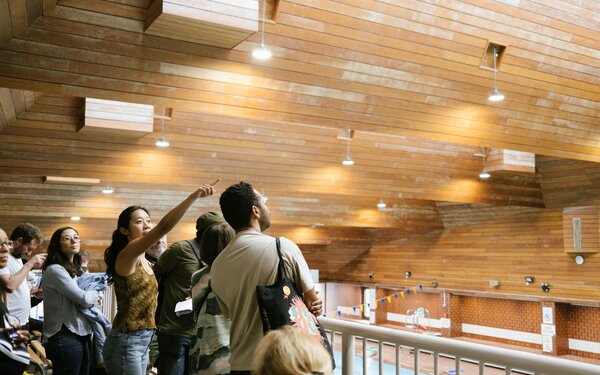
Images © Open City. Brixton Recreation Centre photographed by Nadim Kurimbokus; Vanbrugh Park Estate photographed by Phineas Harper.


A Little Bit of London In Your Inbox Weekly. Sign-up for our free weekly London newsletter. Sent every Friday with the latest news from London!