


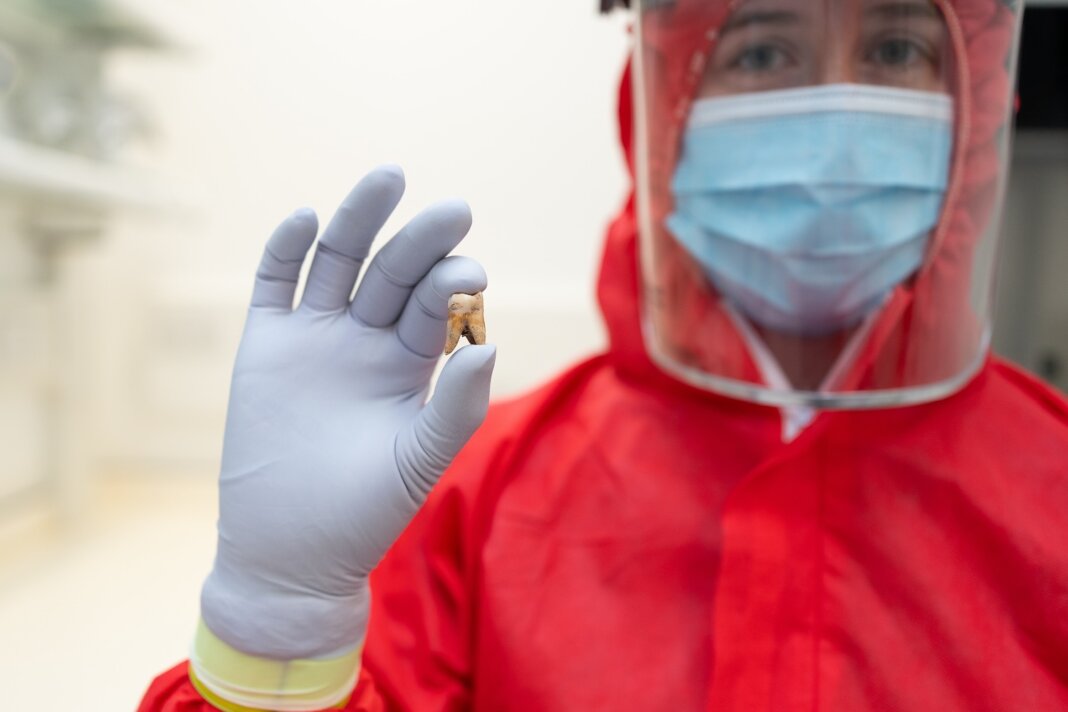
What can a 4,500-year-old tooth tell us about who we are? Rather a lot, as it turns out. This summer the Francis Crick Institute in King’s Cross opens We Go Way Back, billed as the UK’s first exhibition dedicated to ancient DNA — the fragile genetic material of our long-gone ancestors, and one of the most exciting frontiers in the study of human history. It opens on 16 July 2026, it’s completely free, and it runs for almost a full year.
Ancient DNA is exactly what it sounds like: genetic code recovered from the bones and teeth of people who lived hundreds, thousands or even tens of thousands of years ago. The fragments are painstakingly extracted, processed in an ultra-clean laboratory to avoid contamination, and sequenced to reveal the story written into them. Guided by the researchers of the Crick’s Ancient Genomics Laboratory, visitors travel back to our earliest encounters with our Neanderthal and Denisovan cousins, then take a whistle-stop tour through Britain’s shifting populations across the metal ages and the Roman period.
A new science, already rewriting history
Although the first ancient DNA was extracted back in the 1980s, the field only really exploded after the boom in genetic sequencing in the 2010s — making it a remarkably young discipline still on the cusp of major discoveries. The Crick’s lab, sitting inside Europe’s largest biomedical research facility under a single roof, is among those leading the charge. Senior Group Leader Pontus Skoglund and his team use robotics to process hundreds of samples a month, and have built a bank of 1,000 ancient genomes from people who lived in Britain over the past 4,500 years, working with more than 100 museums and heritage sites across the country.

That vast dataset lets the exhibition tell intimate, personal stories. Visitors can untangle the clues from two studies to reconstruct individual lives — among them a person who, in the Roman period, had travelled thousands of miles to reach Cambridge. It’s the kind of detail that adds startling human texture to the broad sweep of history, and occasionally overturns what we thought we knew.
“Ancient DNA promises to transform some important parts of our understanding of the past, potentially rewriting what we used to consider fact and adding surprising twists to our ancestors’ stories. It’s been so exciting to be involved in the exhibition and also to learn a lot along the way.”
Mary Beard, classicist and broadcaster, exhibition steering group
From ancient teeth to modern medicine
It isn’t only historians who stand to gain. Ancient DNA is also a window onto disease. The Crick’s researchers have identified a key gene behind inflammatory bowel disease that was already present in our ancient ancestors, and traced how bacteria and viruses have evolved alongside us over millennia. In the galleries, visitors can search for pathogen DNA in model teeth to learn how a particular disease evolved, and watch those discoveries acted out in shadow puppetry — science storytelling at its most inventive.

“The field of ancient DNA has surged in technical capability over the last two decades, now giving us answers to questions that were previously inaccessible without genetic data. Our lab is expanding the record of our shared history, one ancient sample at a time, and we’re excited to bring visitors to the Crick along with us.”
Pontus Skoglund, Senior Group Leader, Ancient Genomics Laboratory
The exhibition closes with a holographic artwork, Portals: Windows into Human Heritage, by Sheffield-based artist Grace Lee, created with a participatory group and the lab’s researchers, which invites visitors to add their own reflections. Curator Kat Nilsson hopes people leave realising that the story is still being written: “Pontus and his team are adding new puzzle pieces to our shared story all the time, tracing how we’ve migrated, picked up new genetic changes and lived alongside bacteria and viruses over hundreds of thousands of years.”
Accessibility has been built in from the start: the team worked with an access consultant and a panel of blind and visually impaired visitors, and the exhibition offers British Sign Language and captions on its films, plus Easy Read, Braille and large-print guides and sensory packs. A programme of talks, panel discussions and Lates with Mary Beard, Pontus Skoglund and other researchers runs alongside. It follows the Crick’s hugely popular Hello Brain, which drew nearly 80,000 visitors.
If You Go
- What: We Go Way Back — the UK’s first ancient DNA exhibition
- Where: Francis Crick Institute, 1 Midland Road, London NW1 1AT
- When: 16 July 2026 – 2 July 2027, open Wednesday to Saturday
- Admission: Free
- Nearest station: King’s Cross St Pancras
- More: crick.ac.uk
Images © The Francis Crick Institute; laboratory photography by Bethany Lavin.


A Little Bit of London In Your Inbox Weekly. Sign-up for our free weekly London newsletter. Sent every Friday with the latest news from London!