


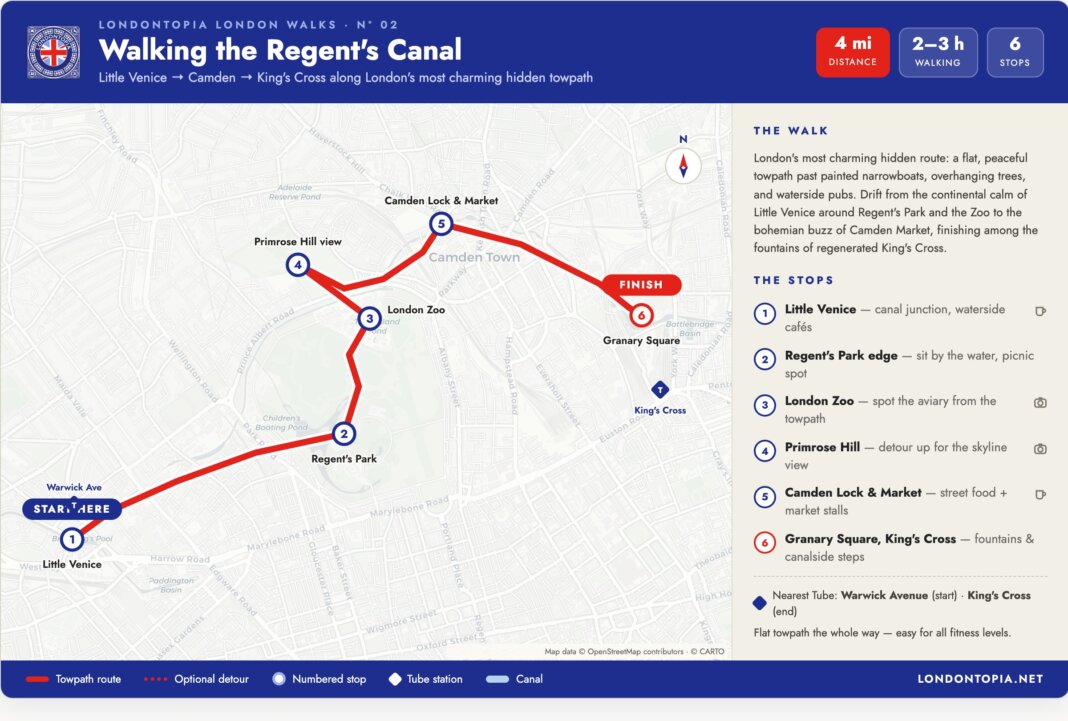

Take this walk with you: download our free, printable PDF map of the route to keep in your pocket — no phone signal required. Download the printable map (PDF) →
The Regent’s Canal, running roughly northwest through London from the Thames to the Grand Union Canal, offers one of the city’s most pleasant walking experiences. The canal, which seems almost European in character with its narrowboats, towpaths, and waterside pubs, provides a completely different experience of London from the usual tourist routes. For visitors wanting to escape crowded streets and experience a more intimate, local side of London, the Regent’s Canal walk is absolutely worthwhile.
The canal was constructed in the early 19th century as a commercial transportation route for goods, and narrowboats still travel it today, though now primarily for recreational rather than commercial purposes. The narrow boats, painted in bright colors and often featuring distinctive designs, are home to some Londoners and represent a particular lifestyle choice—living on the water in the heart of the city. The sight of these boats moored along the canal, with laundry hanging and geraniums blooming from the roofs, creates a charming, almost magical atmosphere.
You can start the walk at Little Venice, where the Regent’s Canal meets the Grand Union Canal. This area, called Little Venice because of its waterside character and the presence of boats, is particularly picturesque. Cafés and restaurants line the water, and there’s a sense of relaxed continental leisure that feels distinct from the frenetic energy of much of central London. Walking from Little Venice along the canal towpath, you begin to understand how different London becomes when you step away from the main streets.
The walk from Little Venice to Camden, which covers roughly two and a half miles, takes about an hour of walking (though you’ll likely take longer because of the temptation to stop and enjoy the views). The canal passes through different neighborhoods, each with its own character. You move from the relatively prosperous, residential feel of the western sections to the grungier, more commercial character of Camden.
As you walk, you’ll notice how the canal creates a linear greenspace through London. Trees overhang the water, ducks and other waterfowl are visible, and there’s a sense of nature that’s otherwise absent from much of central London. The canal provides a corridor of relative quiet and peace through a busy city. The towpath is shared with cyclists and other pedestrians, so you move alongside boats and other walkers in a kind of peaceful coexistence.
Regent’s Park, where the canal passes through a pleasant park area, is a good spot to stop, perhaps pick up food, and enjoy sitting by the water. The park provides access to the canal and is one of the few places where you can easily sit by the water without being in a commercial establishment.
As you move toward Camden, the character shifts. Camden is known for its alternative culture, its markets, its music venues, and its general bohemian character. The canal area around Camden Lock is particularly vibrant, with markets, restaurants, and bars creating a lively atmosphere. Camden Market, which runs along the canal, is one of London’s most distinctive markets, selling everything from vintage clothing to handmade crafts to food from around the world. The market’s energy and diversity make it a thoroughly London experience.
Beyond Camden, if you’re inclined to continue walking, the canal continues southeast toward King’s Cross. The area around King’s Cross has been undergoing significant redevelopment and gentrification, and the canal sections here offer glimpses of both the old, grittier London and the new, more upscale developments that are transforming the area.
The Regent’s Canal walk offers several particular pleasures that distinguish it from other London walking routes. First, it’s genuinely peaceful despite being in the middle of the city. The water buffers sound and creates a sense of separation from the urban surroundings. Second, you experience London neighborhoods that tourists might otherwise miss—you’re walking through residential areas, seeing how Londoners actually live rather than just visiting tourist attractions. Third, the canal itself is beautiful and provides constantly changing views and subjects for photography. Fourth, you have the option of stopping at waterside pubs and cafés throughout the walk, which allows you to experience London’s pub culture in a particularly pleasant setting.
The best times to walk the canal are spring and summer, when the weather is pleasant and the water and towpath are at their most attractive. Autumn can be beautiful as well, with trees changing color. Winter is possible but less pleasant unless you enjoy gray, cold weather walks.
The walk is also accessible to people of varying fitness levels. Because it’s a flat towpath with minimal elevation change, it’s easier than hill-based walks. You can walk the entire length or just sections of it. You can start and finish at any of the many access points, so you’re not locked into a particular route.
For those interested in the industrial and engineering history of London, the canal itself is significant. The early 19th-century engineering that created the canal, the locks that manage water level changes, the bridges that cross the canal—all of these represent technological achievement of their era. The canal was part of London’s infrastructure for moving goods and people, and understanding this history adds another layer of interest to the walk.
One particularly interesting aspect of the canal is how it reveals London’s geography and topography. The canal needs to move through a particular elevation path, and following it shows you the geography of London in a way that walking streets doesn’t always reveal. The locks that raise and lower the canal’s water level allow boats to navigate the terrain.
For visitors interested in the literary and cultural history of London, the Regent’s Canal has associations with various figures—it appears in novels, in paintings, in photographs. The canal is part of London’s cultural memory and has inspired artists and writers over nearly two centuries.
The canal is also a genuinely accessible walk for international visitors. It requires no special equipment, no tickets, no reservations. You simply start walking along the towpath. Unlike many London attractions that require advance booking or have limited hours, the canal is available to you whenever you want to walk it.
For a perfect blend of London culture and outdoor walking, combining a Regent’s Canal walk with a visit to Camden Market provides an excellent half-day or full-day activity. You get the peace and beauty of the canal walk with the energy and diversity of Camden’s markets and street culture. This combination gives you multiple perspectives on London—the quiet, peaceful, nature-oriented version and the energetic, bohemian, culturally vibrant version.


A Little Bit of London In Your Inbox Weekly. Sign-up for our free weekly London newsletter. Sent every Friday with the latest news from London!