


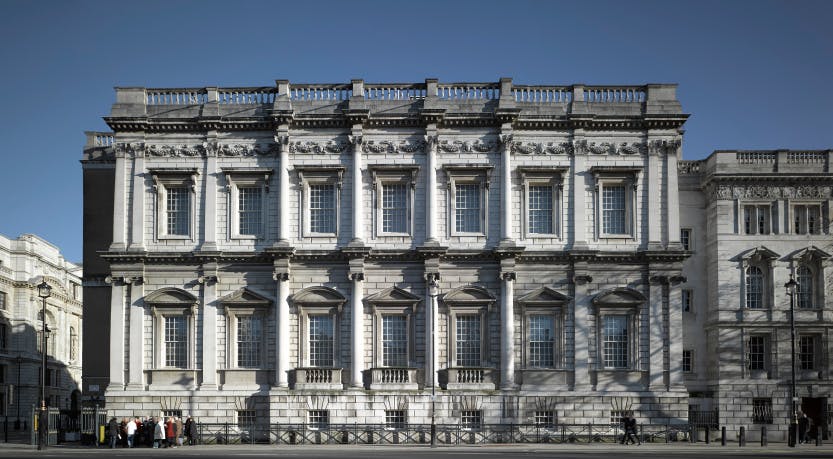
One of London’s best-kept secrets reopens to the public this summer with a brand-new visitor experience — and a chance to lie back beneath one of the greatest painted ceilings in Europe. From 1 August to 20 September 2026, the Banqueting House invites visitors to rediscover 400 years of history, art and architecture, and the extraordinary story of the lost royal Palace of Whitehall.
The Banqueting House is the last complete survivor of that palace — once the principal residence of the Tudor and Stuart monarchs — most of which perished in a catastrophic fire in 1698. It is also home to the magnificent Rubens ceiling, the only work by the Flemish master Peter Paul Rubens still displayed in the very space for which it was created.
Recline beneath a masterpiece
The new experience is designed to be savoured slowly. In the grand Banqueting Hall, visitors are invited to recline on comfortable beanbags and cushioned benches and simply gaze up at Rubens’s ceiling — a serene retreat from the bustle of Whitehall just outside. Specially curated digital content, including podcasts and playlists, helps tell the stories of revolution, restoration and revelry that have played out within these walls, while expert Palace Hosts are on hand to share insights into the building’s architecture, history and art.
For one weekend only, on 15–16 August, BBC Radio 3 presenter Georgia Mann and sound engineer Rob Winter bring their Classical DJ project to the hall, mixing a rich live soundtrack inspired by the drama of the Stuart court and the splendour of the ceiling above. The reopening follows a major project by Historic Royal Palaces, the independent charity that cares for the building, to upgrade its facilities — including a new passenger lift that at last offers step-free access to the Banqueting Hall and the Rubens ceiling.
The last piece of a vanished palace
Completed in 1622, the Banqueting House is a masterpiece of classical architecture designed by Inigo Jones for James I — a startlingly modern building for its day. It was built to stage lavish court entertainments known as ‘masques’, but was also used for diplomatic receptions and for the strange royal ritual of ‘touching’ the sick to cure the ‘King’s Evil’. In 1630, Charles I commissioned Rubens to paint the ceiling: nine canvases glorifying the reign of his father James I, a soaring statement of royal power and the divine right of kings. It was installed in 1636.
Just 13 years later, in one of the most extraordinary ironies in British history, Charles I was led out beneath the very ceiling he had commissioned — and onto a scaffold outside the Banqueting House, where he was executed in January 1649. When fire consumed the rest of the Palace of Whitehall in 1698, the Banqueting House survived. Over the centuries since, it has served as a chapel and a museum, and today stands as an events venue and visitor attraction — a lone, perfect fragment of a palace that has otherwise vanished entirely.
If You Go
- What: Discover the Banqueting House — a new summer visitor experience
- Where: Banqueting House, Whitehall, London SW1A 2ER
- When: 1 August – 20 September 2026 (Classical DJ weekend 15–16 August)
- Tickets: Adults £10, Concessions £8; children under 16 and Historic Royal Palaces members go free. £1 tickets are available for those receiving certain means-tested benefits. Book at hrp.org.uk
- Nearest stations: Westminster, Embankment and Charing Cross
Exterior image © Historic Royal Palaces. Historical view of the Palace of Whitehall by Hendrik Danckerts.


A Little Bit of London In Your Inbox Weekly. Sign-up for our free weekly London newsletter. Sent every Friday with the latest news from London!