
For more than four decades, the BT Tower has been London’s great tease: a 177-meter exclamation mark visible from half the city, and utterly, permanently shut. Now we know rather more about what happens next. Architects Orms have unveiled detailed plans for the tower’s conversion into a hotel at a public consultation in Fitzrovia, and buried in them is the detail Londoners have wanted for 45 years: the public will be allowed back to the top.
The plans went on show on July 13, the second round of consultation on the scheme. A full planning application and listed building consent are due to land with Camden Council this September. Then comes the long wait: BT can’t hand the building over until it decommissions the telecoms equipment still humming away inside, which isn’t scheduled until 2029. Construction starts then, and the doors are expected to open in 2033.
Who’s doing it
The tower was bought from BT Group in early 2024 by MCR, the third-largest hotel owner-operator in the United States, for around £270 million (about $365 million). MCR has form with exactly this sort of thing: it’s the company behind the TWA Hotel at New York’s JFK, which turned Eero Saarinen’s swooping, abandoned 1962 terminal into a functioning hotel rather than a museum piece.
One notable change since the sale: Orms has replaced Heatherwick Studio on the project. Orms is a London practice with a strong line in heritage retrofit, and they’re working with heritage consultants Donald Insall Associates — a reassuring pairing for a Grade II-listed structure that is, essentially, a giant piece of 1960s state engineering.
What’s actually proposed
The tower itself becomes the heart of the hotel, with four rooms per floor wrapped around the original concrete core, and a second staircase inserted for safety. The lower floors of the 1960s base building get retail and food and drink at ground level — plus the entrance to the visitor experience — with hotel rooms on the first and second floors.
Around it, the podium buildings are extended upwards by three to four stories, and the 1930s Howland Building, a former telephone exchange, is converted to hotel and commercial use. Orms also propose stripping back the accretions of the last sixty years: “We will remove unsightly modern additions to the 1960s exterior on the ground floor,” the practice says.
At street level there’s a genuinely public gain: a new public square at the foot of the tower, with pedestrian routes cut through a site that has been a sealed block for decades, and entrances on Howland Street and Maple Street. For the first time you’ll be able to stand at the base of the thing and look up.

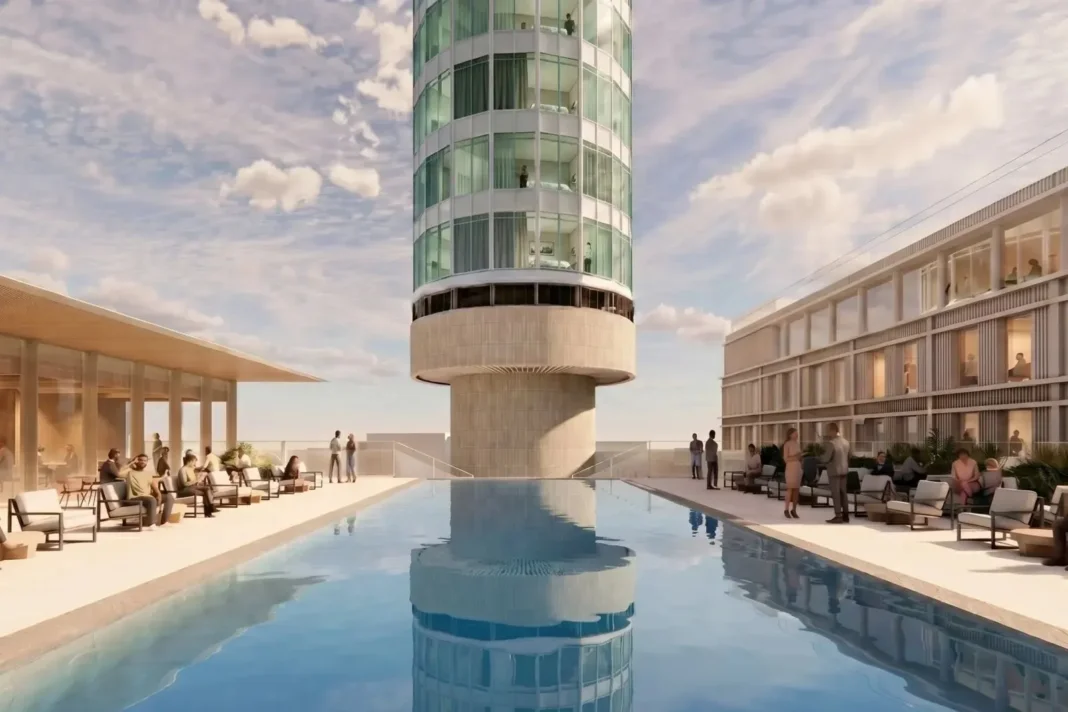
Then there’s the pool. On the fifth floor of the podium, Orms propose a heated, infinity-edge rooftop pool, open year-round and explicitly modeled on the one at MCR’s TWA Hotel. Hotel guests get first refusal, but the public will be able to book a slot subject to availability — swimming in the shadow of the tower, which is a very good sentence to be able to write.
Going back up: the viewing gallery
The headline, though, is the top. The plans include a public viewing gallery in the tower’s revolving crown — the same rotating deck that once carried the restaurant. Visitors would enter from the new square, pass through security, and take a lift up to level 34. It would be the first time the public has been able to ride to the top of the BT Tower in something like 45 years.

One thing to temper expectations on: the revolving restaurant is not coming back. There’s no proposal to revive the old Top of the Tower as a working restaurant, though the plans allow for special events where food and drink feature. The floor will turn again; you just won’t be having your prawn cocktail on it.
A brief history of the building that didn’t exist
For American readers especially, the BT Tower needs some explaining, because its story is faintly absurd. It opened in 1965 as the Post Office Tower, designed by Eric Bedford with G. R. Yeats for the Ministry of Public Building and Works, and it was built for an unglamorous reason: to carry microwave signals across the rooftops of London, which is why it’s a slim cylinder bristling with dishes rather than a conventional office block. At 177 meters (189 with the mast), it was the tallest building in Britain until the NatWest Tower overtook it in 1980.
It was also, briefly, a proper visitor attraction. From 1966 the public could ride to the top, where Butlins — yes, the holiday camp people — ran a revolving restaurant called the Top of the Tower that completed a full rotation every 22 minutes. Then, on the night of October 31, 1971, a bomb exploded near the top of the tower. Nobody was hurt, but the public galleries closed and never really reopened; the restaurant limped on until 1980, and the tower was shut to the public altogether by 1981.
And here is the truly ridiculous part. For years the BT Tower was an official secret. It was left off Ordnance Survey maps and was notionally protected by the Official Secrets Act — this, a 620-foot tower in the middle of central London that you can see from Hampstead Heath, that had a restaurant at the top, and that had been opened by the Prime Minister on national television. The absurdity was finally punctured in 1993 when MP Kate Hoey stood up in the Commons and simply said it out loud, noting that she hoped she was covered by parliamentary privilege. It was the building that officially didn’t exist, in plain sight, for decades. It was Grade II listed in 2003.
Which makes what’s now proposed rather neat: a structure that spent thirty years being publicly invisible and forty-five being publicly inaccessible is, if Camden agrees, about to become one of the few tall buildings in London you can actually walk into. If you want more on the tower itself, we’ve also rounded up ten interesting facts and figures about it.
The Key Facts
- What: Conversion of the Grade II-listed BT Tower into a hotel, with a public viewing gallery, rooftop pool and new public square
- Where: Cleveland Street / Howland Street, Fitzrovia, London W1
- Owner: MCR (bought from BT Group for around £270m (about $365 million) in early 2024)
- Architect: Orms, with Donald Insall Associates as heritage consultant
- Where it’s at: Second public consultation held July 13, 2026; planning application and listed building consent expected at Camden Council in September 2026
- Timeline: BT vacates and decommissions by 2029; construction follows; opening expected 2033
- Nearest station: Goodge Street or Great Portland Street
- More: bttowerconsultation.co.uk and the Architects’ Journal
All computer-generated images: Orms.


A Little Bit of London In Your Inbox Weekly. Sign-up for our free weekly London newsletter. Sent every Friday with the latest news from London!