

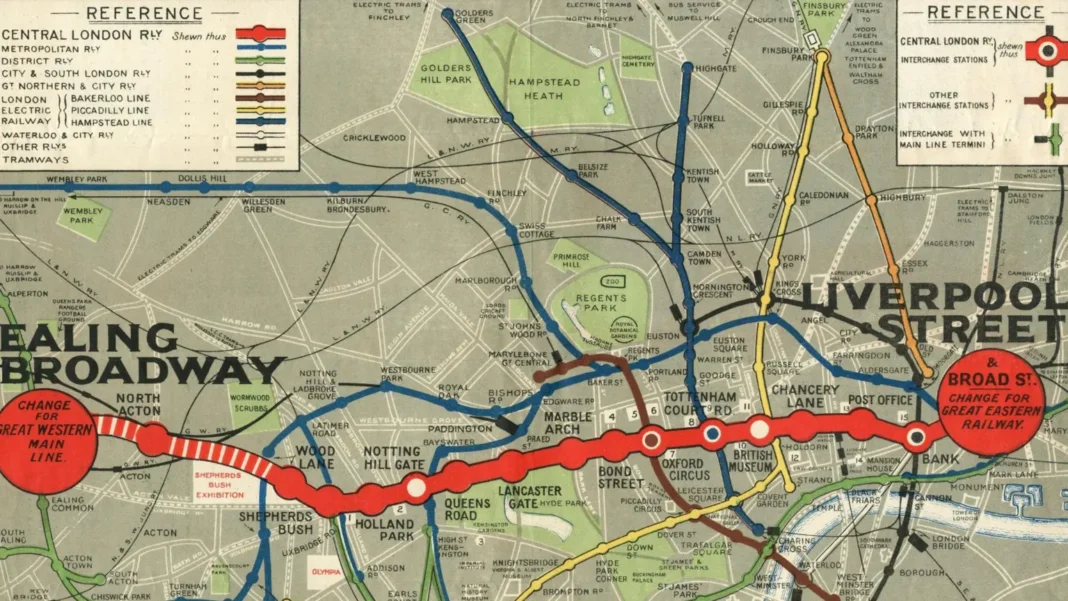


On July 30, 1900, London witnessed the birth of what would become one of its most vital transport arteries. The Central London Railway, as it was originally known, opened its doors to the public with a simple promise: travel anywhere along its route for just two pence. That modest beginning would earn it the affectionate nickname “The Twopenny Tube” – a moniker that would eventually expand to encompass the entire Underground network.
Today, 125 years later, the Central Line stands as London’s longest Underground line, stretching 46 miles across the capital and serving 49 stations from the Essex countryside at Epping to the western suburbs of West Ruislip and Ealing Broadway. Colored red on the iconic Tube map, it carries over 300 million passenger journeys annually, making it one of the busiest lines on the network.
The Central Line’s story is one of engineering ambition, wartime resilience, and constant evolution. From its pioneering use of electric lighting in stations to its transformation of unused tunnels into aircraft factories during World War II, from Victorian elegance to modernist functionality, the line reflects the broader history of London itself. It has weathered two world wars, adapted to changing technology, and continues to serve as a crucial link connecting London’s financial heart with its residential communities.
As we mark this remarkable milestone, these 125 facts celebrate not just the engineering achievement of boring through London’s clay and chalk, but the human stories, innovations, and moments of history that have shaped one of the world’s most famous transport networks. The Central Line remains what it has always been: London’s vital east-west corridor, carrying millions of passengers through the capital’s story, one journey at a time.
Opening & Early History
- The Central line opened on 30 July 1900 as the Central London Railway.
- The line between Shepherd’s Bush and Bank was formally opened on 30 June 1900, public services beginning on 30 July.
- It was extremely well used from the outset, partly because of the flat fare of two old pence (2d), which inspired the name the ‘Twopenny Tube’.
- By the end of the year carrying nearly 15 million passengers in its first year of operation.
- When the Central Line Railway opened in 1900, it was called the Twopenny Tube, referencing the price of a ticket. The nickname has stuck ever since!
- The nickname “The Tube” didn’t originate as a term for the whole of the Underground? It actually started as a nickname for the Central Line.
- The Central London Railway (CLR) was given permission in 1891 for a tube line between Shepherd’s Bush and a station at Cornhill.
- The Central London Railway (CLR) was first proposed in 1889, but things moved slowly. Parliamentary approval took three years, and raising money took four more.
- In April 1896 work started, using the same Greathead shield technology as the City & South London Railway (C&SLR).
- However, the CLR had wider tunnels than its cramped predecessor.
Engineering & Construction
- The tunnels were bored with the nominal diameter of 11 feet 8+1⁄4 inches (3.562 m), increased on curves, reduced to 11 feet 6 inches (3.51 m) near to stations.
- The tunnels generally rise approaching a station, to aid braking, and fall when leaving, to aid acceleration.
- Engineers made the tunnels running away from stations slope downwards to help trains speed up, and upwards when approaching stations to assist braking.
- The line was built following the streets above rather than running underneath buildings, because purchase of wayleave under private properties would have been expensive.
- While the tracks in opposite directions mostly run side-by-side, in some places one line runs above another due to lack of space, with platforms at different levels at St Paul’s, Chancery Lane and Notting Hill Gate stations.
- The positive outer rail is 40 mm (1.6 in) higher than on other lines, because even after reconstruction work the tunnels are slightly smaller.
- The platforms at Redbridge are the shallowest on the Tube lines, only 7.9m (26ft) below the road.
- The lifts are the shallowest on the London Underground network, having a descent of just 0.67 metres at Redbridge.
- All the platforms were lit by Crompton automatic electric arc lamps, and other station areas by incandescent lamps.
- The Central London Railway was the first underground railway to have electric lighting in its stations.
Length & Stations
- The Central line serves 49 stations over 46 miles (74 km), making it the network’s longest line.
- At 74km, the Central line is the longest on the Underground.
- The longest journey without a change on the Underground is on the Central line between West Ruislip and Epping, which is 55km and takes 1 ½ hours.
- It is one of only two lines on the Underground network to cross the Greater London boundary, the other being the Metropolitan line.
- Some stations at the north-eastern end of the Central line are in the Epping Forest district of Essex.
Color & Design
- The Central is finally shown in red on the underground map from 1935.
- The first pocket underground map appears. The Central line is blue! in 1908.
- A new version of the underground map is drawn up by the amusingly named FH Stingemore. This time, the Central is depicted in a not-so-fetching shade of dirty yellow in 1925.
- Printed in red on the Tube map today.
- The name today is simply a shortened version of the original name.
World War II
- The unused tunnels between Leytonstone and Newbury Park were equipped by the Plessey Company as an aircraft components factory, opening in March 1942 and employing 2,000 people.
- Production moved underground to the 4km-long twin tunnels between the unfinished Leytonstone and Gants Hill stations.
- Another unfinished station at Bethnal Green was taken over by the local council to use as an air raid shelter.
- On 3 March 1943 crowds believing an air raid had started rushed into the station. A woman tripped in the dark on a set of stairs, and in the ensuing panic 173 people were crushed to death.
- Prior to World War II, stations began an upgrade, lengthened to allow for eight-car trains. However, the war effort ceased the construction.
- The tunnels between Wanstead and Gants Hill to the east were turned into munitions factories during WW2.
- Also during WW2, the train tunnels at Redbridge were used as an aircraft parts factory.
Extensions & Development
- The extension to Liverpool Street opened the following year, providing access to the Great Eastern Railway station in 1912.
- The line was extended westwards with a loop serving a single platform at Wood Lane for the 1908 Franco-British Exhibition.
- A major extension to the west opens, with trains now running as far as Ealing Broadway in 1920.
- Construction restarted after the war, and the western extension opened as far as Greenford in 1947 and West Ruislip in 1948.
- The eastern extension opened as far as Stratford in December 1946.
- In 1947, the line opened to Leytonstone, and then Woodford and Newbury Park.
- The extension transferred to London Underground management in 1949, when Epping began to be served by Central line trains.
- The powers to extend the line to Denham were never used due to post-war establishment of the Green Belt around London.
Rolling Stock & Technology
- A total of 85 eight-car trains were built for the Central line and 5 four-car trains were built for the Waterloo & City line of 1992 Stock.
- Upon entering service in April 1993, the new trains gradually replaced the previous 1962 tube stock, which was completely withdrawn two years later.
- These trains can reach a top speed of about 62 miles per hour (100 km/h).
- The 1992 stock was finalised following extensive testing of the three 1986 tube stock prototype trains.
- Initially electric locomotives hauled carriages, but the heavy locomotives caused vibrations that could be felt on the surface.
- During 1902–1903, the carriages were reformed into multiple units using a control system developed by Frank Sprague in Chicago.
- The first 8-car trains of 1992 Stock entered service in 1993.
- ATP was commissioned from 1995–97 and ATO from 1999–2001, with a centralised control centre in West London.
- The Central line has mostly been operated by automatic train operation since a major refurbishment in the 1990s, although all trains still carry drivers.
- The original propulsion for the trains was manufactured by a consortium of ABB and Brush Traction, and was one of the first examples of microprocessor-controlled traction featuring a fibre-optic network.
Accidents & Safety
- On 25 January 2003 a 1992 Stock train with approximately 500 people on board train derailed as it entered Chancery Lane station.
- 32 passengers received minor injuries in the Chancery Lane derailment.
- The cause of the derailment was determined to be the detachment of the rearmost traction motor on the fifth car, caused by a gearbox failure.
- The entire 1992 Stock fleet was withdrawn from service the same afternoon, and the Central and Waterloo & City lines were closed for several weeks.
- Suicides on the Central Line from people jumping in front of trains caused the Underground to install suicide pits beneath the tracks in 1926.
Passenger Usage & Operations
- In terms of total passengers, the Central line is the third busiest on the Underground.
- In 2019, over 300 million passenger journeys were recorded on the line.
- Opened in 1900, it is the busiest line of the London Underground, with more than 260,000,000 passengers each year.
- As of 2013, it operated the second-most frequent service on the network, with 34 trains per hour (tph) operating for half-an-hour in the westbound direction during the morning peak.
- On 19 August 2016, London Underground launched a 24-hour service on the Victoria and Central lines.
- 24 hours between Ealing Broadway and Loughton/Hainault via Newbury Park on Friday and Saturday for Night Tube service.
Depots & Maintenance
- There are three depots: Ruislip, Hainault and White City.
- White City depot first opened in 1900 when the initial line went into operation.
- Ruislip and Hainault depots were completed in 1939.
- During the Second World War, anti-aircraft guns were made at Ruislip Depot and the U.S. Army Transportation Corps assembled rolling stock at Hainault between 1943 and 1945.
- As part of the construction of the Westfield London shopping centre, the depot at White City was replaced underground, opening in 2007.
Historical Stations
- The Central line loses a station when the British Museum stop is closed. New platforms at nearby Holborn made the station redundant in 1933.
- Wood Lane: This station opened on 14 May 1908 but closed on 22 November 1947.
- British Museum: This station opened on 30 July 1900 but closed on 24 September 1933.
- Blake Hall: First served on 25 September 1949, but closed on 31 October 1981.
- Ongar: First served on 25 September 1949, but closed on 30 September 1994.
- The Epping to Ongar shuttle service was steam-hauled until 1957 but had never been widely used.
- That section is now operated as a preserved railway – the Epping Ongar Railway.
Notable Features
- The Central Line has the most stations without a building above ground. These stations include Bank, Bethnal Green, Chancery Lane, Gants Hill, and Notting Hill Gate.
- Greenford station was home to the Underground’s last wooden escalator, which was removed in 2015.
- Is the only station on the network with an ornate, medieval-style Hammerbeam Roof (usually only used in great halls or cathedrals) at one of its stations.
- The only tube station named after a tree – Loughton.
- The bus shelter attached to it is Grade II listed. The station isn’t at Gants Hill.
- Destroyed by a V1 “doodlebug” bomb during WW2 – one station was destroyed.
Commercial & Cultural Impact
- In 1909, Harry Gordon Selfridge attempted to make a major push to have the Bond Street station named changed to “Selfridges” as a way to promote his store.
- In July 1907, the fare was increased to 3d for journeys of more than seven or eight stations.
- A reduced fare of 1d, for a journey of three or fewer stations, was introduced in 1909, and season tickets became available from 1911.
- The fact that it appealed to shoppers as well as commuters was also crucial to its early success.
Corporate History
- The Central London Railway was absorbed into the Underground Group on 1 January 1913.
- The formation of London Transport (LT) in 1933 unified London’s public transport operations.
- Initially called the Central London line, the name was shortened in 1937.
- As of this year, it officially becomes the Central line in 1937.
Modern Technology
- 4G and 5G mobile signals become available at some stations and tunnels (around Notting Hill Gate, and Tottenham Court Road). The whole line should have signals by the end of 2024 as of 2023.
- In December 2022, additional mobile coverage, including 5G connectivity, launched at a small subset of stations and tunnel segments on the Central line.
- Since 2019, TfL is doing a major refurbishment on the Central line units as part of the Central Line Improvement Programme (CLIP).
Future Plans
- TfL could only afford to order Piccadilly line trains at a cost of £1.5bn. However, the contract with Siemens includes an option for 100 trains for the Central line in the future.
- This would take place after the delivery of the Piccadilly line trains in the 2030s.
- These trains would have an open gangway design, wider doorways, air conditioning and the ability to run automatically with a new signalling system.
Unique Engineering Facts
- The main purpose of the London Underground’s ventilation fans is to extract hot air from the tunnels.
- There are 20 miles (32 km) of cut-and-cover tunnel and 93 miles (150 km) of tube tunnel, the other 55% of the system running above ground.
- Most of the central London deep-tube line stations, such as those on the Central and Piccadilly lines, are higher than the running lines to help with deceleration when arriving and acceleration when departing.
Historical Personalities
- “It will be a great boon to our great city”. That’s the verdict of the Prince of Wales, soon to become Edward VII, on opening the Central London Railway.
- For some reason — possibly to amuse future trivia compilers — the novelist and all-round-wit Mark Twain is also onboard during the opening ceremony.
International Comparisons
- It was the first Tube to serve central London.
- The line was opened as the Central London Railway in 1900, crossing central London on an east–west axis, as the third deep-level Tube line to be built after electric trains made them possible.
Recent History
- In 1980, London Underground tried to close the entire Epping-Ongar line. but a reduced service was implemented instead.
- In 1993, brand new 1992 Stock trains were introduced.
- On 30 September 1994, the Epping-Ongar branch closed down to be converted into a heritage railway.
- On 17 February 1995, the 1962 stock trains were withdrawn and the line was converted into a full 1992 Stock operation.
Architecture & Design
- Many of its stations are of historic interest, from turn-of-the-century Central London Railway buildings in west London to post-war modernist designs on the West Ruislip and Hainault branches.
- As well as Victorian-era Eastern Counties Railway and Great Eastern Railway buildings east of Stratford, from when the line to Epping was a rural branch line.
Refurbishment Projects
- From 2011 to 2012, the Central line 1992 Stock units underwent a refresh of both the interior and exterior.
- Some of the noticeable changes included the addition of the new “Barman” seat moquette, new brighter interior lighting and the installation of new window frames.
- This includes a complete overhaul of the interior and adding new features such as new wheelchair spaces, PIS (Passenger Information Screens), and CCTV installed throughout the train.
Operational Statistics
- A total of 700 train cars were built between 1991 and 1994 for the 1992 Stock.
- Train Formation: Driving Motor – Non-Driving Motor (Central x 4 / Waterloo & City x2).
- Train Length: Central: 434 feet / Waterloo & City: 216 feet 4 ins.
- Train Weight: Central: 170 tonnes / Waterloo & City: 86 tonnes.
Legacy & Impact
- With its long history, extensive route, and strategic importance in the London Underground network, the Central line remains a crucial component for urban transport.
- The Central line, due to its age and the variety of its station architectures, offers a fascinating tour through the evolution of London Underground design.
- The Elizabeth line, which began most of its core operation from 24 May 2022, provides interchanges with the Central line at Stratford, Liverpool Street, Tottenham Court Road, Ealing Broadway, and Bond Street, relieving overcrowding.
Final Historical Facts
- The Central London Railway in 1900, known as the “twopenny tube” was among the pioneering tube lines.
- Operation began on this first electric underground railway in 1890 with a uniform fare of twopence for any journey on the 3-mile (5-km) line – referring to an earlier line, but the Central Line continued this pricing tradition.
- The CLR was extended to Wood Lane (near White City) in 1908 and Liverpool Street in 1912.
- Today, 125 years after opening, the Central Line continues to serve millions of passengers annually as London’s longest Underground line, connecting communities across the capital and maintaining its vital role in the city’s transport network.
These 125 facts showcase the remarkable journey of the Central Line from its opening on July 30, 1900, to its current status as one of London’s most important transport arteries, celebrating both its historical significance and ongoing evolution.
A Little Bit of London In Your Inbox Weekly. Sign-up for our free weekly London newsletter. Sent every Friday with the latest news from London!