


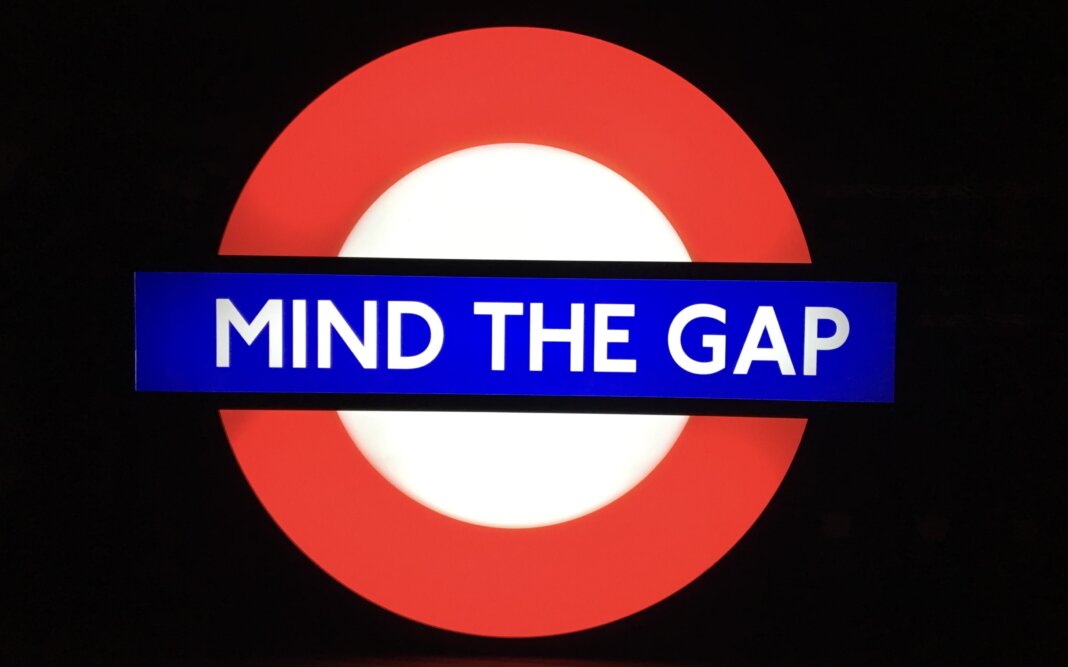
If there’s one piece of London culture that has transcended its origins to become an international symbol of the city, it’s “Mind the Gap.” The phrase is so iconic that it appears on everything from T-shirts to coffee mugs to tourist merchandise. Visitors come to London specifically hoping to hear it announced on the Tube. It’s become almost mythical—a uniquely British warning that somehow encapsulates everything charming about the London Underground.
But what does it actually mean, and why is a simple safety announcement so deeply embedded in London’s cultural identity?
The Literal Meaning
“Mind the gap” is, quite simply, a safety announcement warning passengers about the space between the Tube train and the platform. It’s not deep. It’s not poetic. It’s just practical advice: be careful of the gap.
When you board a Tube train, there’s typically a small space—usually a few inches—between where the platform ends and where the train begins. This gap exists because the Tube tunnels are circular and not all trains fit exactly flush against every platform. For most people, this gap is irrelevant; you simply step from the platform into the train without noticing it exists.
But if you’re not paying attention—if you’re elderly, or if you have mobility issues, or if you’re a small child—that gap can be a hazard. A foot could catch. A wheelchair wheel could slip. So the Underground’s safety system includes an announcement: “Mind the gap,” which is to say, “Pay attention to the gap. Be careful.”
“Mind” is good old British English—American English would be “watch out for” or “be aware of,” but in British English, “mind” means exactly that: pay attention, be mindful.
The Announcement Itself
The “Mind the Gap” announcement is made at certain Tube stations—not all of them, which adds to its specialness. Some stations have more dangerous gaps than others, and the announcement is used where the gap is particularly pronounced.
What makes the announcement legendary is the voice. The most famous version comes from a recording made in 1972 by Margaret McCollum, a voice actress who recorded the announcement for the Circle, District, and Hammersmith & City lines. Her calm, measured British accent delivering the warning became part of the texture of the Tube experience. Passengers heard her voice hundreds of times, and she became a kind of unofficial mascot of the London Underground.
The recording was used for decades, making Margaret McCollum one of the most-heard voices in the city. Regular Tube users heard her voice more often than they heard many of their family members’ voices. For people who commuted on those lines, that recorded message became as much a part of their daily rhythm as breathing.
The Widow and the Legend
The most charming part of the “Mind the Gap” story involves the announcement itself and the version recorded for the Embankment station. In 2014, after Margaret McCollum had passed away, the London Underground decided to retire the Embankment recording and replace it with a new one. But before they did, they shared a detail about the woman behind the voice.
Margaret McCollum’s husband had been killed in a train accident on the Underground in 1952. One interpretation of her decision to become a voice actress for the Tube—and her particularly careful, deliberate delivery of safety warnings—is that she was helping protect others from experiencing the tragedy she had experienced. She spent decades warning people to mind the gap, to pay attention, to be careful.
It’s a beautiful story, and whether it’s entirely factually precise or slightly romanticized over time, it speaks to something true: her voice became associated with safety and care. She warned people thousands of times a day, and nobody was ever hurt by a gap while her voice was on duty.
Why It Became So Iconic
“Mind the Gap” transcended its practical function and became cultural shorthand for London itself. There are several reasons for this.
First, it’s quintessentially British. The phrase captures something about British formality and understatement. It’s not “WATCH OUT! GAP DANGER!” It’s the polite, measured, slightly old-fashioned “Mind the Gap.” There’s something charmingly reserved about warning people of danger with such gentility.
Second, it’s caught millions of tourists’ imaginations. Visitors who’ve never ridden the Tube know about “Mind the Gap” because it shows up in every article about London, on every T-shirt in every tourist shop, in every piece of pop culture that references the city. It’s become a symbol of authenticity—if you’ve heard “Mind the Gap,” you’ve experienced London.
Third, it’s been immortalized in popular culture. The phrase shows up in movies, TV shows, and even as a James Bond-style action film title. The combination of the historical recording, the charming British accent, and the simplicity of the message makes it endlessly quotable and shareable.
The Modern Version
These days, many Tube lines have moved to newer announcement systems. Some stations still use the original Margaret McCollum recording, but many now use a newer, digitized version recorded by Emma Clarke, which was introduced in the 2000s. The new version is clearer and more modern, but it lacks the charm of the vintage recording.
There’s actually been a bit of fond resistance to the new announcements. Regular Tube users can be surprisingly nostalgic about the old one. It’s not just about safety; it’s about continuity and identity. That voice was part of the fabric of commuting on the Tube for generations.
Visiting and Hearing It
If you want to hear the announcement yourself, you’re in luck—it’s still being used at certain stations. The best places to hear it are the Embankment station, which is famous for it, and the East London line stations, where you can still catch the original recording. Don’t be disappointed if you don’t hear it everywhere, though. Modern Tube lines are moving toward more comprehensive digital announcements, and the gap announcements are becoming increasingly historical.
Why It Matters
In the end, “Mind the Gap” matters because it represents something larger about London and about Britain itself. It’s a small, practical, utterly sensible piece of public communication that has become beloved and iconic. It’s not grand or romantic. It’s not the Tower of London or Westminster Abbey. It’s a safety announcement, and yet it’s become an essential part of the London experience.
There’s something deeply British about that. Take something functional, deliver it in calm, measured tones, and let it accumulate meaning over decades through sheer repetition and genuine affection. That’s not unlike London itself, really—a city that’s endlessly fascinating not because of bombast or excessive marketing, but because of depth, history, and the small rituals that make daily life work.
So when you visit London and someone plays the “Mind the Gap” recording for you, or when you hear it announced during your own Tube journey, you’re not just hearing a practical safety warning. You’re hearing a piece of cultural history, recorded by a woman who cared about safety, delivered in a voice that’s meant something to millions of people, translated into a symbol of the city itself.
Mind the gap, indeed.


A Little Bit of London In Your Inbox Weekly. Sign-up for our free weekly London newsletter. Sent every Friday with the latest news from London!