


Bath, the extraordinary Georgian city in Southwest England, is one of those places that feels impossibly picturesque, impossibly well-preserved, and impossibly far from the chaos of London until you realize it’s only ninety minutes away by train. A day trip to Bath is entirely feasible, surprisingly affordable, and absolutely worthwhile. You’ll arrive in a city that looks like it’s been frozen in time somewhere around 1800, with stunning architecture, compelling history, and an atmosphere that’s both elegant and genuinely welcoming to visitors.
Getting There: The Train Journey
Bath is most easily reached from London Paddington Station, and the journey is straightforward. Regular trains depart from Paddington throughout the day, and the journey takes approximately ninety minutes on a direct train. This is actually part of the appeal — ninety minutes is long enough to feel like you’re genuinely traveling somewhere, but short enough that it’s not a burden.
The train tickets vary depending on when you book and when you travel. Off-peak return tickets (approximately £30-40 (about $40-54) per person) are available if you’re flexible with timing. Peak-time tickets during weekday mornings and evenings are more expensive. The strategic approach for a day trip is traveling mid-morning or early afternoon and returning late afternoon or early evening, thus avoiding peak pricing.
The train journey itself is pleasant — you watch the landscape transform from London’s urban sprawl to increasingly rural countryside as you move southwest. It’s genuinely enjoyable. The trains are comfortable and have a café car if you want coffee or snacks during the journey.
Bath Spa Station is in the heart of the city, meaning you literally arrive at the center of Bath. Walking out of the train station, you’re immediately in the historic city. It’s remarkably convenient for a day trip.
Bath’s Scale and Walkability
Bath is genuinely small in a way that makes it perfect for a day trip. The historic city center is eminently walkable — you can stroll from one end to the other in about fifteen minutes. The major attractions are clustered within a few streets of each other. You’re not going to exhaust yourself walking, and you’re not going to be confused about where to go next.
The Georgian architecture is consistent throughout the city center — honey-colored limestone buildings, elegant crescents and squares, refined streets that genuinely look like stepping into history. The visual appeal is immediate and persistent. It’s not just the famous landmarks that are beautiful — the whole city is gorgeous.
The Roman Baths: Windows into Two Millennia
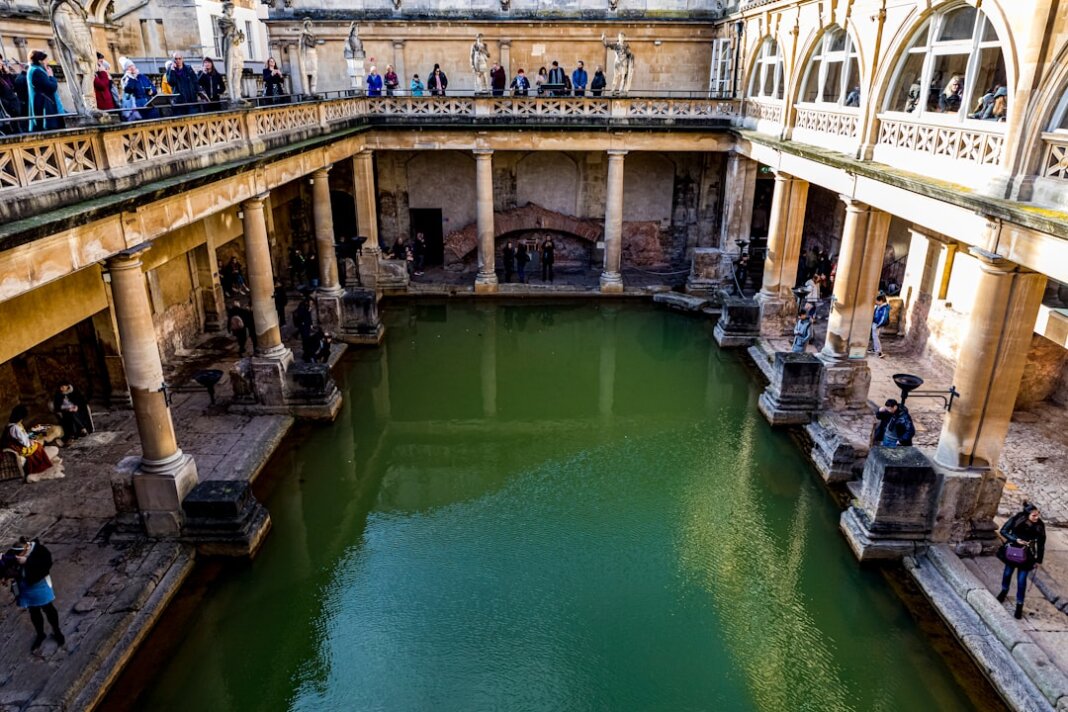
The Roman Baths are Bath’s most famous attraction, and they genuinely live up to the reputation. The baths are a remarkably well-preserved complex built by the Romans nearly 2,000 years ago around naturally hot spring water. You descend into the remains of the Roman complex — the Great Bath with its steaming water, the surrounding rooms and corridors — and you’re immediately transported to a completely different era.
The museum surrounding the baths provides historical context and artifacts. You can actually see the coins, pottery, and remnants of Roman life in Bath. It’s not just architecture; it’s genuine artifacts providing windows into how Romans actually lived and bathed in this place.
What makes the experience compelling is that the baths are still fed by hot spring water. The water is genuinely hot (slightly over 40 degrees Celsius). You can dip your hand in and feel the heat that Romans felt 2,000 years ago. Your children can touch the water and experience something genuinely unchanged across millennia.
The Roman Baths are understandably crowded, particularly during peak tourist season. Arriving early in the morning or visiting mid-week minimises crowds. The museum is excellent, the audio guide is informative, and the overall experience is genuinely worthwhile.
Bath Abbey: Breathtaking Gothic Architecture
Bath Abbey sits immediately adjacent to the Roman Baths, and it’s an extraordinary example of English Gothic architecture. The exterior is all soaring pointed arches and intricate stone work. The interior is breathtaking — high vaulted ceilings, beautiful stained glass, intricate fan vaulting.
For an admission charge (approximately £9 (about $12)), you can enter the abbey and spend time exploring. The scale is genuinely impressive. The craftsmanship is evident. Sitting in the abbey, allowing the space and light and sound to affect you, is a genuinely moving experience even if you’re not religious.
The abbey’s location means it’s literally on your walking route through Bath’s historic center. You can visit the Roman Baths and then immediately step into the abbey. Combined, they provide two thousand years of Bath’s history.
The Royal Crescent: Perfection in Stone
The Royal Crescent is Bath’s most famous architectural landmark — a semicircular row of Georgian townhouses curving gracefully up a hillside. It was built in the 1770s and remains one of the most perfectly executed examples of Georgian architecture in the world. The geometry is striking. The proportion is elegant. It’s the kind of place that makes you understand why people become obsessed with architecture.
The Royal Crescent is particularly striking because it’s a residential address — real people live in these houses. It’s not a museum or a preserved curiosity. It’s an active neighborhood that happens to be extraordinary. You can walk around the crescent, admire the architecture, look at the views across Bath from the front of the crescent, and understand why Georgian builders and architects pursued perfection.
Number One Royal Crescent is open as a museum (approximately £16 (about $21)) where you can see how the interior of one of these houses was decorated and furnished. If you have time and are interested in how people actually lived, it’s worthwhile. For most visitors, walking around the crescent itself and admiring the exterior architecture is sufficient.
The Circus and Queen Square: More Georgian Perfection
If you loved the Royal Crescent, you’ll love the Circus — another remarkable example of Georgian architecture on a circular plan. The Circus is composed of three curved rows of townhouses forming a complete circle. The architecture is elegant, the proportions are perfect, and it’s genuinely beautiful.
Queen Square is another Georgian gem, and Bath is actually full of these extraordinary squares and crescents. Each one represents a moment in 18th-century architectural ambition. Walking from one to another, admiring the stone work and proportions, is a genuinely excellent way to spend a Bath afternoon.
Bath’s Spa Culture: Thermae Bath Spa
Thermae Bath Spa is a modern spa facility built around Bath’s naturally hot spring water. You can actually bathe in naturally heated spring water in a rooftop pool overlooking Bath’s Georgian architecture. It sounds luxury and indeed it’s not cheap (approximately £44-49 (about $59-66) per person for a two-hour session), but it’s genuinely unique.
If you have limited time on a day trip and want to maximize sightseeing, Thermae Bath Spa might not be your priority. If you have extra time and want a genuinely Bath-specific experience (bathing in hot springs that have attracted people for two thousand years), it’s worthwhile.
The Jane Austen Centre
Bath was home to Jane Austen for several years, and the Jane Austen Centre celebrates her life and work. The small museum includes period furnishings, excerpts from her letters, and context about her life in Bath. If you’re a Jane Austen enthusiast, the center is worthwhile. For the casual visitor, it’s interesting but not essential.
The center includes a period tearoom (genuine Regency-era inspired food and tea) that’s lovely for a break and genuinely good for understanding how people actually ate and drank in Austen’s era. The tearoom alone might be worth visiting if you want an excellent Bath experience.
Eating in Bath: Gastronomy and Culture
Bath has developed a genuinely excellent food scene. There are Michelin-starred restaurants, excellent casual dining, and wonderful independent restaurants showcasing everything from fine dining to comfort food. Because Bath is smaller and less of a tourist trap than some UK destinations, the food is often genuinely good without being prohibitively expensive.
Sally Lunn’s is a Bath institution — a historic house now operating as a restaurant famous for “Sally Lunn buns” (a sweet, fruit-filled bread). It’s touristy but genuinely charming and the buns are actually quite good.
The Pump Room restaurant is in an elegant Georgian building and serves traditional British food. It’s pricey but you’re paying for the experience and location as much as the food. Having lunch in the Pump Room while overlooking the Roman Baths is genuinely lovely.
For casual eating, Bath has excellent independent cafés, pubs, and restaurants. The city is small enough that wandering and finding somewhere appealing is straightforward.
How Much Time Do You Need?
A full day trip to Bath is realistic and satisfying. You could arrive mid-morning, spend the afternoon visiting the Roman Baths, exploring the architecture, perhaps visiting Bath Abbey and the Royal Crescent, having dinner, and catching an evening train back to London. You’d have a genuinely full Bath experience without feeling rushed.
If you’re more leisurely, an overnight stay in Bath is genuinely worthwhile. A night in a Georgian townhouse, a morning exploring at a slower pace, makes for a more complete experience. But it’s absolutely possible to do Bath as a day trip and have an excellent experience.
Practical Considerations: Weather and Crowds
Bath is particularly beautiful in spring and autumn. The Georgian architecture looks stunning in golden afternoon light. Summer weekends are crowded, but the city’s small size means even crowded Bath is manageable. Winter visits are lovely if you don’t mind cold weather — the architecture is beautiful, the city feels more local and less touristy.
The city is built on hills, which means comfortable shoes are important. You’ll be walking up and down gradual inclines throughout your visit. It’s not strenuous, but it’s noticeable.
The Bigger Picture: Why Bath Matters
Bath matters because it’s one of the finest examples of 18th-century city planning and architecture in the world. The Georgian architects and builders created something genuinely beautiful and functional. Walking through Bath is understanding how urban beauty is created, maintained, and valued. It’s not just a tourist destination — it’s a lesson in how humans can build places that remain moving and beautiful across centuries.


A Little Bit of London In Your Inbox Weekly. Sign-up for our free weekly London newsletter. Sent every Friday with the latest news from London!