
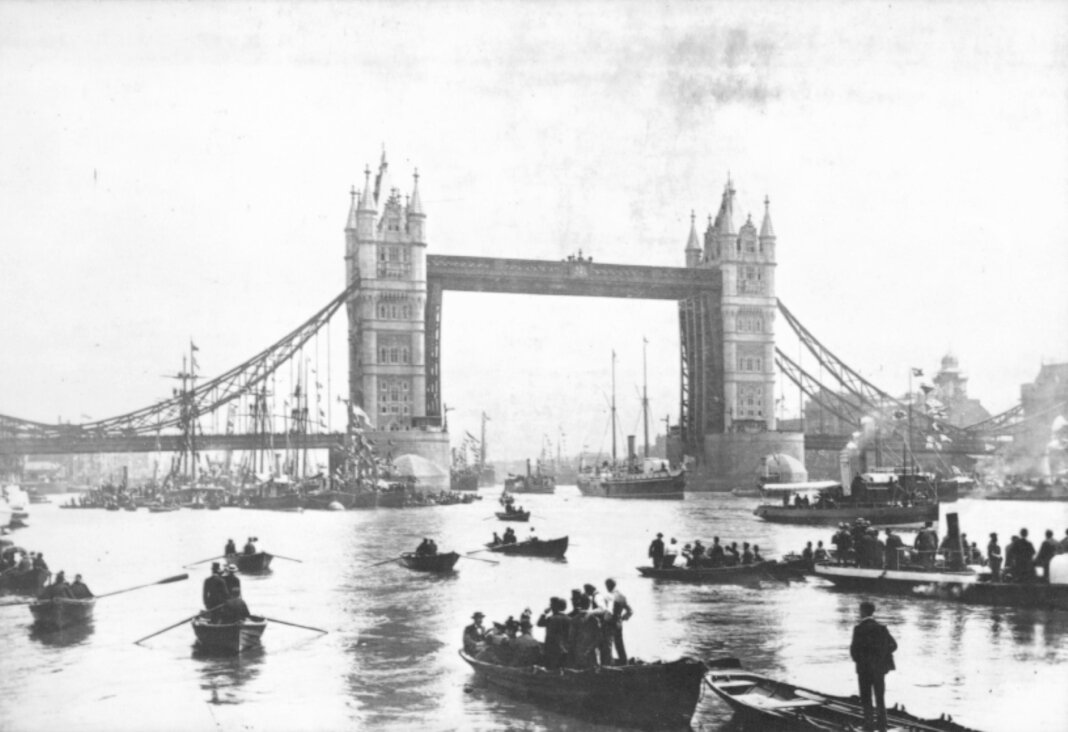


On June 30, 1894, the Prince of Wales (the future Edward VII) presided over the opening ceremony of Tower Bridge, London’s newest Thames crossing and what would become the city’s most iconic landmark. The ceremony itself was a grand Victorian spectacle—banquets, speeches, and pomp—but the real marvel was the bridge itself: a combination of Gothic architecture and cutting-edge hydraulic engineering that could lift its roadway to allow tall ships to pass. The opening represented eight years of construction, decades of planning, and the solution to a uniquely London problem: how to connect the rapidly expanding East End with the South Bank while maintaining access to the Pool of London’s busy docks.
The need for Tower Bridge had been obvious for years. By the 1870s, London had expanded massively east of London Bridge, but there was only one crossing below London Bridge—a tunnel at Rotherhithe that was impractical for horse-drawn vehicles and pedestrians. East End residents and businesses faced a nightmare commute to reach south London, having to travel miles west to cross the Thames. Meanwhile, the Pool of London—the stretch of river between London Bridge and Tower Bridge—remained vital for shipping, with hundreds of vessels arriving daily to load and unload at riverside wharves. Any new bridge had to accommodate both road traffic and shipping, seemingly incompatible requirements.
The City of London Corporation, which governed the City and had responsibility for Thames crossings within its jurisdiction, held a competition in 1876 to find a solution. Over fifty designs were submitted, ranging from the practical to the fantastical. Some proposed high-level bridges that would allow ships to pass underneath, others suggested tunnels, and many imagined various lifting or swinging mechanisms. The committee debated for years, rejecting designs and reopening submissions, before finally accepting a design by Horace Jones, the City Architect, working with engineer John Wolfe Barry, in 1884.
Jones and Barry’s design was brilliant. They proposed a bascule bridge—essentially two enormous seesaws—that could lift to allow ships through, combined with high-level walkways that remained open when the bridge was raised. To appease architectural critics who worried a purely functional iron bridge would look crude near the Tower of London, they clad the steel framework in Cornish granite and Portland stone, creating Gothic towers that complemented the nearby medieval fortress. This decision to prioritize aesthetics as well as function would prove crucial to the bridge’s enduring appeal.
Construction began in 1886 and employed 432 workers over eight years. The engineering challenges were immense. Each bascule weighs over 1,000 tons but had to be balanced so precisely that relatively little power was needed to lift it. The original hydraulic system used steam engines to pump water into hydraulic accumulators, creating the pressure needed to power the hydraulic engines that lifted the bascules. The counterweights were perfectly calibrated, and the whole mechanism could raise the bridge in about five minutes—fast enough to not paralyze traffic but slow enough to be safe.
The foundations required innovative engineering. Massive piers had to be sunk into the riverbed to support the towers, each pier requiring thousands of tons of concrete and masonry. The construction site was treacherous, with workers laboring in caissons (pressurized chambers) below the waterline, risking decompression sickness (“the bends”) and other hazards. Several workers died during construction, their sacrifice remembered in the bridge’s completion but often forgotten in celebrations of its beauty.
The opening ceremony on June 30, 1894, was classic Victorian pomp. The Prince of Wales, representing Queen Victoria, presided over formal ceremonies that included speeches praising British engineering and the City’s forward-thinking. The bridge was blessed, banquets were held, and the bascules were raised for the first time in public, demonstrating the mechanism that would become the bridge’s defining feature. The crowd of dignitaries and ordinary Londoners watched amazed as the massive roadway tilted skyward, allowing a waiting ship to pass through.
The immediate impact was transformative. Suddenly, East End residents could easily reach south London for work, shopping, or leisure. Areas south of the bridge in Bermondey and Rotherhithe became more accessible and began developing rapidly. The bridge quickly became both vital infrastructure and tourist attraction, with people coming to watch the bascules lift and to walk across this marvel of Victorian engineering.
The high-level walkways, accessed by stairs and lifts in the towers, allowed pedestrians to cross even when the bridge was raised. However, they quickly gained a reputation as haunts for pickpockets and prostitutes, being relatively secluded and poorly monitored. The walkways closed in 1910 due to low usage and concerns about crime, remaining closed until 1982 when they reopened as part of the Tower Bridge Exhibition, offering spectacular views to tourists.
The bridge had to lift frequently in its early decades—sometimes several times a day—as ships regularly navigated to the Pool of London. The procedure became routine: bridge operators received notice that a ship was approaching, pedestrians and vehicles were stopped, the bascules rose, the ship passed through, the bascules lowered, and traffic resumed. This happened so often that delays became part of East London life, though far preferable to the alternative of having no convenient crossing at all.
The bridge survived both world wars relatively unscathed, though it was considered a strategic asset and defended against potential German attack. During World War II, the mechanism was protected with sandbags and additional armor, and plans existed to destroy the bridge if German invasion seemed imminent. Fortunately, these measures proved unnecessary, and the bridge emerged from the war intact and still functioning.
One of the bridge’s most famous incidents occurred in 1952 when a number 78 bus had to jump the gap when the bridge began opening before the driver could stop. The driver, Albert Gunter, made a split-second decision to accelerate and jump the three-foot gap as the bascule lifted, landing safely on the other side. He received £10 for his quick thinking and became a local hero, though the incident prompted improvements to the traffic light system warning of imminent bridge lifts.
The bridge underwent major changes over the decades. The original hydraulic system, powered by steam until 1976 when it was converted to electricity, was finally replaced with an electro-hydraulic system in 2008, modernizing the mechanism while preserving its reliability. The bridge has been repainted several times, with color schemes changing from the original chocolate brown and cream to the red, white, and blue applied for Queen Elizabeth II’s Silver Jubilee in 1977, to the current blue and white introduced in 2010 after historical research.
Today, Tower Bridge lifts only a few times per week, usually for historic vessels or special occasions. The Port of London has moved far downstream, and large ships no longer navigate to the Upper Pool regularly. Yet the bridge remains fully functional, maintained carefully so it can lift whenever needed, a Victorian mechanism still performing its intended function over 130 years after construction.
The opening of Tower Bridge represented more than just solving a transport problem. It demonstrated Victorian London at its most ambitious—willing to spend vast sums (£1,184,000, equivalent to over £140 million today) on infrastructure that was also beautiful, creating a landmark that served both practical and symbolic purposes. The bridge showed that engineering could be art, that utilities could be monuments, and that solving practical problems could create lasting beauty.
Tower Bridge’s opening in 1894 gave London one of its most enduring icons, a silhouette recognized worldwide as representing the city. What started as a solution to East End transport problems became a symbol of London itself, proof that great cities need great infrastructure, and that when vision combines with skill and resources, the results can last for centuries.
A Little Bit of London In Your Inbox Weekly. Sign-up for our free weekly London newsletter. Sent every Friday with the latest news from London!