


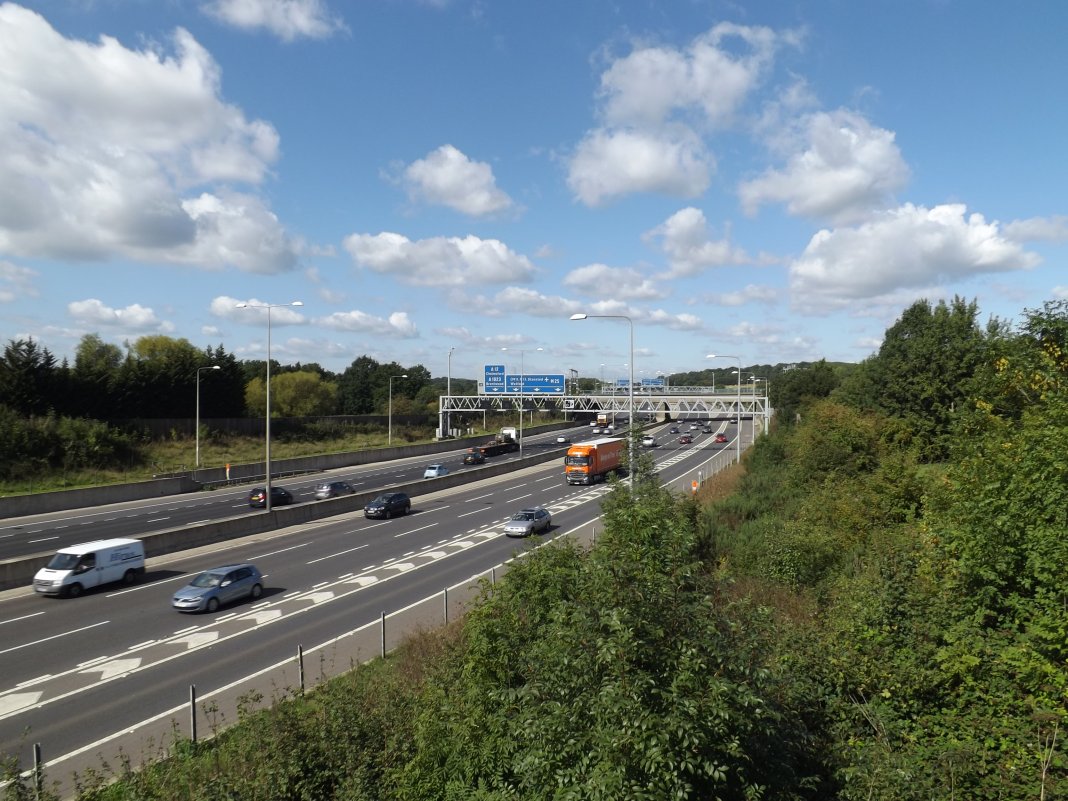


Few pieces of infrastructure inspire such a potent mixture of necessity, frustration, and dark humor as the M25, London’s orbital motorway that has earned the dubious nickname of “Britain’s Longest Car Park.” This 117-mile ring of tarmac encircling the capital has become far more than just a road—it’s a cultural phenomenon, a daily trial for millions of commuters, and paradoxically, one of the most important yet most despised pieces of infrastructure in British history.
The M25’s importance to London and the wider Southeast cannot be overstated. It carries over 200,000 vehicles per day on its busiest sections—far exceeding its original design capacity of 88,000—and serves as the vital circulatory system for one of the world’s great cities. Yet mention the M25 to any regular user, and you’re likely to hear tales of horror: six-hour journeys to travel thirty miles, missing flights at Heathrow despite leaving hours early, or the peculiar phenomenon of coming to a complete standstill at 2 AM for no discernible reason. The motorway has inspired books, songs, and countless hours of radio traffic reports, becoming as much a part of London’s identity as Big Ben or the Thames.
Key Facts
- The M25 is 117 miles (188 km) long, making it one of Europe’s longest orbital roads, though contrary to popular belief, it’s not actually the longest city bypass in Europe—that honor goes to the Berliner Ring at 122 miles
- Construction took 11 years from 1975 to 1986, cost £909 million (approximately £3 billion in today’s money), and was officially opened by Margaret Thatcher on October 29, 1986
- The motorway has 31 junctions, crosses or runs alongside 25 rivers, goes through two tunnels (including the Holmesdale Tunnel), and despite being called “London’s orbital,” only a tiny section actually falls within Greater London boundaries
- Variable speed limits were introduced in 1995, making the M25 the first UK motorway to use this system, while the busiest section between junctions 13 and 14 carries over 219,000 vehicles daily—nearly 2.5 times its design capacity
- The M25 has generated £1 billion in economic benefits annually but also costs the UK economy an estimated £2 billion per year in lost productivity due to congestion, with drivers spending an average of 44 hours per year stuck in M25 traffic
History
The story of the M25 begins not with grand visions of a modern motorway but with a series of disconnected bypass schemes dating back to 1905, when the Royal Commission on Motor Cars first proposed a ring road around London. The idea languished for decades, resurfacing periodically in various forms—the County of London Plan in 1943, the Greater London Plan in 1944, and the Abercrombie Plan, which envisioned four ring roads around the capital.
The modern conception of the M25 emerged in the 1960s when the Ministry of Transport began seriously considering an orbital motorway. The original plans called for four ring roads, labeled A through D, with Ring C roughly corresponding to what would become the M25. The innermost rings were eventually abandoned due to fierce opposition from London residents who faced demolition of their homes, leaving only the outermost ring to proceed—though even this faced significant resistance.
The planning process was tortuous, with over 39 public inquiries held between 1973 and 1983. Every section faced opposition from local communities, environmental groups, and landowners. The route had to navigate around historic estates, protected woodlands, and areas of outstanding natural beauty. In some cases, the opposition succeeded in forcing expensive compromises—the road was put in cutting near Leatherhead to preserve the view from Box Hill, and special wildlife crossings were built to protect local fauna.
Construction began in 1975, proceeding in a piecemeal fashion with different sections built by different contractors at different times. This fragmented approach would later contribute to some of the motorway’s problems, as sections designed to different standards were forced to connect. The work was massive in scale, requiring the movement of millions of cubic meters of earth, the construction of numerous bridges and viaducts, and the creation of complex interchanges with existing roads.
The first section opened in 1975 between South Mimms and Potters Bar (junctions 23 to 24), though it wouldn’t be designated as part of the M25 until later. Progress was slow and expensive, with costs escalating far beyond initial estimates. Environmental protesters, including a young Swampy who would later become famous for anti-road protests, attempted to halt construction at various points, though with limited success.
When Prime Minister Margaret Thatcher officially opened the completed motorway on October 29, 1986, she hailed it as “one of the engineering achievements of the century.” The ceremony took place near Junction 22, with Thatcher cutting a ribbon stretched across the carriageway. Transport Secretary John Moore predicted it would “transform travel around London and the Southeast.”
The transformation came quickly, though not quite as officials had hoped. Within months of opening, it became clear that traffic projections had been wildly optimistic. The motorway that was supposed to last well into the 21st century before needing expansion was effectively full from day one. The original two-lane sections were immediately inadequate, and plans for widening began almost before the opening ceremony bunting had been taken down.
The 1990s saw the first major expansion projects, with sections widened to four lanes. This work, carried out while keeping the motorway open, created years of additional congestion and gave birth to the infamous “cone zones” that seemed to spring up overnight and last for years. The introduction of variable speed limits in 1995 was an attempt to manage flow without physical expansion, making the M25 a pioneer in “smart motorway” technology.
The new millennium brought more ambitious projects. Between 2003 and 2012, the section between junctions 5 and 7 was widened to five lanes in each direction, making it one of the widest motorways in Europe. This £1.25 billion project included the construction of new bridges and the reconfiguration of several junctions. Yet even this massive expansion failed to solve the congestion problem—traffic simply expanded to fill the available space, a phenomenon known as “induced demand.”
The 2010s saw the introduction of “smart motorway” sections, where the hard shoulder could be used as a running lane during busy periods. This controversial system, monitored by hundreds of cameras and controlled from the Highways England control center at Godstone, has increased capacity but raised safety concerns after several fatal accidents involving broken-down vehicles with nowhere to escape the traffic flow.
Today, the M25 carries over 200,000 vehicles daily on its busiest sections, with some parts handling nearly 220,000 vehicles—a far cry from the 88,000 originally planned for. The motorway has been widened, upgraded, and “improved” countless times, yet congestion remains its defining characteristic. Rush hour on the M25 now effectively runs from 6 AM to 8 PM, with the traditional morning and evening peaks merging into one long, slow crawl.
Legacy
The M25’s legacy is complex and contradictory, much like the motorway itself. On one hand, it has been transformative for London and the Southeast, enabling economic growth, connecting communities, and making possible the modern commuter belt that stretches far beyond the traditional boundaries of Greater London. On the other, it has become a symbol of the limitations of road-building as a solution to transport problems and the impossible challenge of keeping pace with ever-growing demand.
Economically, the M25 has been both a blessing and a curse. It has enabled the development of major commercial centers around its periphery—Lakeside Shopping Centre, the business parks of the Thames Valley, and countless distribution centers that rely on orbital connectivity. The motorway has made Heathrow and Gatwick more accessible to a wider catchment area and allowed London to function as a truly regional capital. Studies suggest the M25 generates over £1 billion annually in economic benefits through improved connectivity and reduced journey times—when it’s flowing freely.
Yet the cost of congestion is staggering. The Centre for Economics and Business Research estimates that M25 delays cost the UK economy £2 billion annually in lost productivity. The average commuter using the M25 loses 44 hours per year to traffic jams, time that could otherwise be productive or spent with family. The psychological toll is harder to quantify but no less real—the stress of daily M25 commutes has become a recognized factor in workplace wellbeing discussions.
Culturally, the M25 has achieved an almost mythical status in British life. It has inspired Chris Rea’s “Road to Hell,” written about his experiences on the motorway, and Iain Sinclair’s book “London Orbital,” where the author walked the entire route as a form of modern pilgrimage. The motorway features in countless films and TV shows as shorthand for modern frustration, from “The Good Life” to “The Office.” Radio traffic reports have elevated certain junctions to infamous status—mention Junction 10 (Wisley) or Junction 25 (Enfield) to any regular user, and watch them shudder.
The M25 has fundamentally altered the geography of Southeast England. Towns and villages that were once distinct communities have been absorbed into London’s commuter belt. Property prices along the M25 corridor reflect proximity to junctions, with estate agents advertising homes as “minutes from Junction X.” The motorway has created its own economic geography, with logistics companies, hotels, and services clustering around interchanges.
Environmentally, the M25’s impact has been profound and largely negative. The motorway cuts through what was once countryside, creating a concrete barrier between London and the Home Counties. Noise pollution affects communities miles from the road itself, while air quality along the corridor regularly exceeds safe limits. The motorway has severed ancient woodlands, disrupted wildlife corridors, and contributed significantly to the Southeast’s carbon emissions. Recent efforts to mitigate these impacts, including noise barriers and pollution monitoring, have had limited success.
The M25 has also influenced transport planning philosophy across Britain and beyond. Its rapid descent from visionary solution to congested nightmare has become a cautionary tale about induced demand and the impossibility of building your way out of congestion. The motorway proved that adding road capacity in isolation simply encourages more driving, a lesson that took decades and billions of pounds to learn. Modern transport planning increasingly focuses on modal shift—moving people from cars to public transport—rather than endless road expansion.
Sociologically, the M25 has created new patterns of living and working. The “M25 effect” describes how the motorway has enabled people to live further from their workplaces, accepting longer commutes in exchange for larger homes or better schools. This has contributed to the hollowing out of London’s middle-class population while creating pressure on green belt land around the orbital. The motorway has made possible a lifestyle of extreme commuting, with some people traveling the entire orbital daily for work.
The M25 has even influenced language and humor. “Going orbital” has entered the vernacular to describe losing one’s temper, while “M25 syndrome” is used to describe the particular form of stress-induced rage that comes from sitting motionless on what should be a high-speed road. The motorway has spawned countless jokes, memes, and satirical pieces, becoming a shared reference point for anyone who has experienced its unique frustrations.
Technologically, the M25 has often been a testbed for new traffic management systems. It was the first UK motorway to use variable speed limits, among the first to implement comprehensive CCTV coverage, and has pioneered the use of smart motorway technology. The masses of data collected from the M25 have contributed to advances in traffic flow theory and the development of predictive traffic management systems.
Further Research
• Highways England M25 Information – www.gov.uk/government/organisations/highways-england – Official source for current traffic conditions, planned roadworks, and the history of upgrades and improvements to the motorway
• London Transport Museum – www.ltmuseum.co.uk – Contains archives and exhibitions about London’s transport history, including the planning and construction of the M25 and its impact on the capital
• The National Archives – www.nationalarchives.gov.uk – Houses original planning documents, public inquiry records, and government papers relating to the M25’s conception and construction
• Iain Sinclair’s “London Orbital” (2002) – Essential reading for understanding the M25’s cultural impact, documenting the author’s walk around the entire motorway and the communities it affects
• Institution of Civil Engineers Library – www.ice.org.uk/knowledge-and-resources/ice-library – Technical papers and engineering reports about the M25’s construction, including solutions to the unique challenges of building such a massive orbital motorway
A Little Bit of London In Your Inbox Weekly. Sign-up for our free weekly London newsletter. Sent every Friday with the latest news from London!