


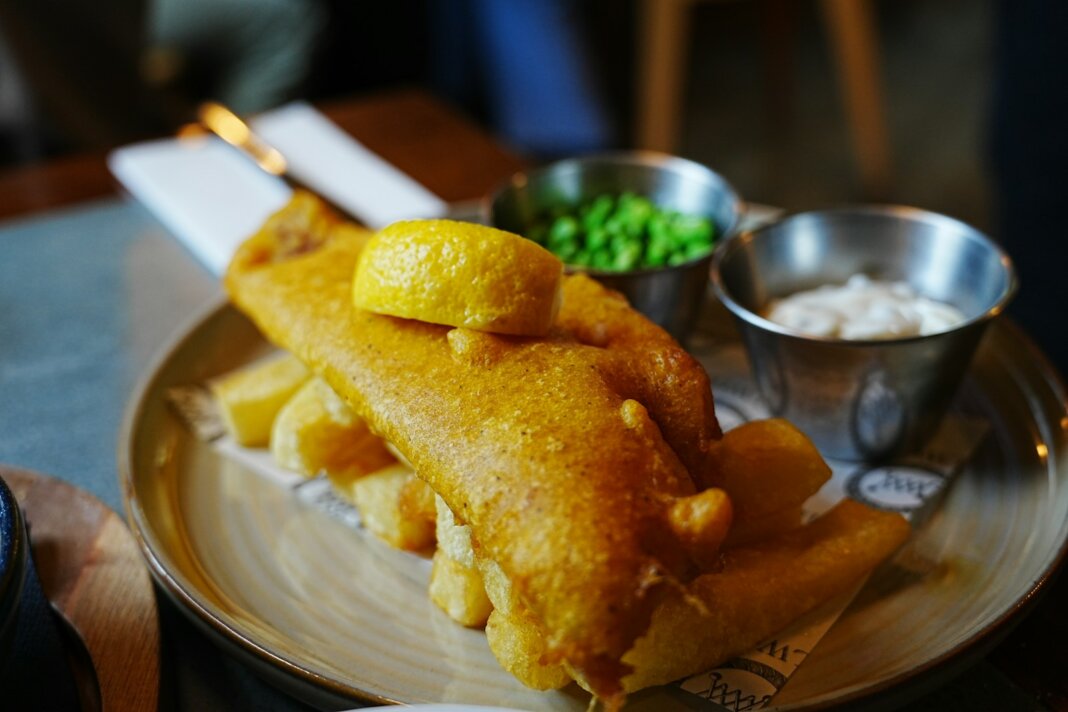


Few dishes capture the essence of London’s cultural identity quite like fish and chips. This golden combination of battered white fish and crispy potato chips represents far more than mere sustenance—it embodies centuries of immigration, innovation, and social history that helped forge modern London’s character. From its origins in the Jewish communities of the East End to its status as the ultimate democratic meal during two world wars, fish and chips has served as both comfort food and cultural bridge, uniting Londoners across class, ethnicity, and generation.
The dish’s journey through London’s streets tells the broader story of how the city has always been shaped by newcomers bringing their culinary traditions. What began as separate trades—Portuguese Jewish refugees frying fish in the Sephardic tradition and vendors selling chipped potatoes—eventually merged in the bustling neighborhoods of Victorian London to create something entirely new. This fusion would go on to define British cuisine and become so deeply embedded in the national consciousness that Winston Churchill famously called fish and chips “the good companions” during World War II.
Today, fish and chips remains London’s most enduring takeaway, with over 10,000 shops across the UK serving an estimated 382 million portions annually. Yet its significance extends beyond mere numbers. In a city where culinary trends rise and fall with remarkable speed, the humble chippy represents continuity, tradition, and the remarkable ability of immigrant communities to create lasting cultural contributions that become quintessentially British.
The story of fish and chips in London begins not with a single inventor, but with the convergence of culinary traditions, technological innovation, and the social upheaval of the Industrial Revolution. The dish’s origins trace back to the 16th century, when Sephardic Jews, who likely comprised 20 percent of the population, held positions in the high court in Portugal during the period of relative tolerance under Moorish rule. However, in 1496, after the end of Moorish rule, King Manuel I married Isabel of Spain, who was not so aligned with the idea of religious freedom. Her ultimatum: Their betrothal would mean the expulsion of Jews from Portugal.
These displaced communities carried with them a treasured culinary tradition—pescado frito, fish coated in flour and fried in oil. The dish of white fish, typically cod or haddock, was fried in a thin coat of flour. Its name? ‘Pescado frito’, a particular favourite of Sephardic Jews, who fried it on Fridays to prepare for the Sabbath. The batter was supposed to preserve the fish so it could be eaten cold the following day. This practical solution to religious dietary requirements would eventually transform into one of London’s most beloved foods.
By the Victorian era, “Fish Fried in the Jewish Fashion” was extremely popular in the working class districts of London, particularly in the East End. The literary evidence of this growing popularity appears in Charles Dickens’ works, with Charles Dickens mentions a “fried fish warehouse” in Oliver Twist, first published in 1838. These early establishments were quite different from modern fish and chip shops, primarily serving fried fish alongside bread or baked potatoes to hungry workers in London’s rapidly industrializing neighborhoods.
The transformation from separate trades to the combined dish we know today occurred during the 1860s. It was in the 1860s that fried fish and chipped potatoes were brought together as a meal. No one knows exactly who brought the two components together or when, but it’s likely that it happened in industrial northern towns or in the streets and alleys of London. The most widely accepted account credits Joseph Malin, opened the first recorded combined fish-and-chip shop in Bow, East London, circa 1860.
Joseph Malin’s story reflects the broader narrative of immigrant entrepreneurship that has always characterized London’s food scene. He was an Ashkenazi Jew who came to London’s East End from Eastern Europe. Although history tells us little about Malin’s early life, Ashkenazi Jews were heavily persecuted in Eastern Europe and Russia around this time. Hundreds of thousands of Jews fled during the pogroms from 1881, with 140,000 arriving in the UK from the 1880s onwards. Malin’s innovation—combining the Sephardic tradition of fried fish with the emerging popularity of fried potatoes—created something revolutionary.
The rapid expansion of fish and chips throughout London was facilitated by remarkable technological advances. The development of the steam powered trawler brought fish from all over the North Atlantic, Iceland and Greenland and the steam railways allowed easy and fast distribution of the fish around the country. These innovations meant that inexpensive fish could be transported to all corners of the U.K. by the second development, extensive railroad lines. Fried fish consumption rocketed with these technological advances.
The social significance of fish and chips during this period cannot be overstated. In the early days, fish and chips was thought to be cheap, nasty food for the poor and fried fish dealers had a bad reputation. They were well known for using fishmonger’s unwanted scraps and leftovers, were thought to be dirty and unsanitary, and were seen as ‘abominations to be shunned’. However, this perception gradually changed as quality improved and the dish gained respectability.
By the turn of the 20th century, fish and chips had become deeply embedded in London’s working-class culture. By 1861 at least 300 people were selling fried fish on the poorer streets of London, and by 1910 there were over 25,000 of them across the UK. The shops were typically originally small family businesses, often run from the ‘front room’ of the house, representing not just commercial enterprises but community institutions where neighbors gathered and social bonds were forged.
The industry faced its greatest test during the two World Wars, when fish and chips paradoxically reached new heights of cultural importance. The British government safeguarded the supply of fish and chips during the First World War and again in the Second World War. It was one of the few foods in the UK not subject to rationing during the wars, which further contributed to its popularity. In an effort to boost morale at home, Prime Minister David Lloyd George made sure that fish and chips stayed off the ration list during World War I.
The wartime significance reached its apex during World War II, when Winston Churchill famously referred to a hot meal of fish and chips as “the good companions”. This wasn’t merely culinary preference—it represented shrewd political understanding. Fish and chips became so essential to the diet of the ordinary man and woman that one shop in Bradford had to employ a doorman to control the queue at busy times during 1931, and during wartime, Queues were often hours long when the word went round that the chip shop had fish!!
The post-war period saw fish and chips cement its status as a democratic meal that transcended class boundaries. Fish and chips were primarily seen as a working class meal in Britain up until the time of World War II. During the time of the war, Britain’s population had to ration most basic foods and goods – however, fish and chips were not subject to these restrictions, and so many people, regardless of class, began to love the meal. This wartime democratization permanently altered the dish’s social standing, transforming it from working-class sustenance into a national treasure.
Fish and chips has evolved far beyond its humble origins to become a cornerstone of London’s cultural identity and a symbol of the city’s remarkable capacity for absorbing and transforming immigrant contributions into quintessentially British institutions. The dish has become an integral part of British culinary heritage, evoking a sense of nostalgia and tradition. For many Britons, enjoying fish and chips is not just about satisfying hunger, but also about connecting with their cultural roots and shared experiences.
The cultural significance extends well beyond mere sustenance. Fish and chips have often been associated with seaside towns and coastal communities, further reinforcing their connection to British identity. The image of enjoying a portion of fish and chips by the seaside has become an enduring symbol of Britishness, evoking images of family holidays, leisurely weekends, and a sense of national pride. This association has been particularly strong in London, where the tradition of day trips to Brighton, Southend, and other coastal destinations often centered around sharing fish and chips while watching the sea.
In contemporary London, fish and chips continues to serve as both comfort food and cultural bridge. There are also estimated to be around 10,500 fish and chip shops across the UK – that’s eight for every one McDonald’s outlet, making British Fish and Chips the nation’s favourite take-away. These statistics underscore the remarkable resilience of traditional food culture in the face of globalization and the proliferation of international fast-food chains.
The dish’s nutritional value, once dismissed by food snobs, has gained newfound respect. Fish and chips are a valuable source of protein, fibre, iron and vitamins, providing a third of the recommended daily allowance of vitamins for men and nearly half for women. The famous English nutritional scientist Magnus Pyke cited it as an example of a traditional dish once jeered at by food snobs and even censured by health food devotees but now fully appreciated as a nutritious combination.
London’s fish and chip shops today represent a fascinating blend of tradition and innovation. Many establishments maintain time-honored recipes and cooking methods while adapting to contemporary demands for sustainability, dietary diversity, and elevated dining experiences. In 1871 the third ever fish shop opened its doors to London at 47 Endell Street and since that time it has served over six generations of Londoners with the finest fish and chips at what is now The Rock and Sole Plaice, demonstrating the remarkable longevity of well-established chippies.
A Little Bit of London In Your Inbox Weekly. Sign-up for our free weekly London newsletter. Sent every Friday with the latest news from London!