


May 1, 1851, was the day London decided to throw the ultimate house party and invite everyone on Earth to come admire British ingenuity, industrial might, and shameless self-confidence. The Great Exhibition wasn’t just a trade show – it was the Victorian era’s equivalent of a world’s fair, space program, and national advertisement all rolled into one magnificent spectacle housed in the most revolutionary building of the 19th century.
The idea belonged to Prince Albert, Queen Victoria’s German husband, who had the kind of ambitious vision that only comes from being married to the most powerful monarch in the world and having lots of time to think about how to improve things. Albert looked at Britain’s industrial dominance and decided that what the world really needed was a comprehensive demonstration of human progress, with Britain naturally taking center stage as the undisputed champion of innovation and manufacturing excellence.
The concept was audacious even by Victorian standards: gather the finest products, inventions, and innovations from around the globe, display them in a single massive exhibition, and invite the entire world to come to London to marvel at the wonders of the Industrial Age. It was part educational mission, part commercial opportunity, and part imperial propaganda, wrapped in the high-minded rhetoric of international cooperation and human advancement.
But the Exhibition needed a venue worthy of its ambitions, and London in 1851 didn’t possess anything nearly grand enough. This is where the story becomes truly remarkable. Instead of settling for an existing building or constructing something conventional, the organizers decided to create a structure that would be as revolutionary as the exhibits it housed.
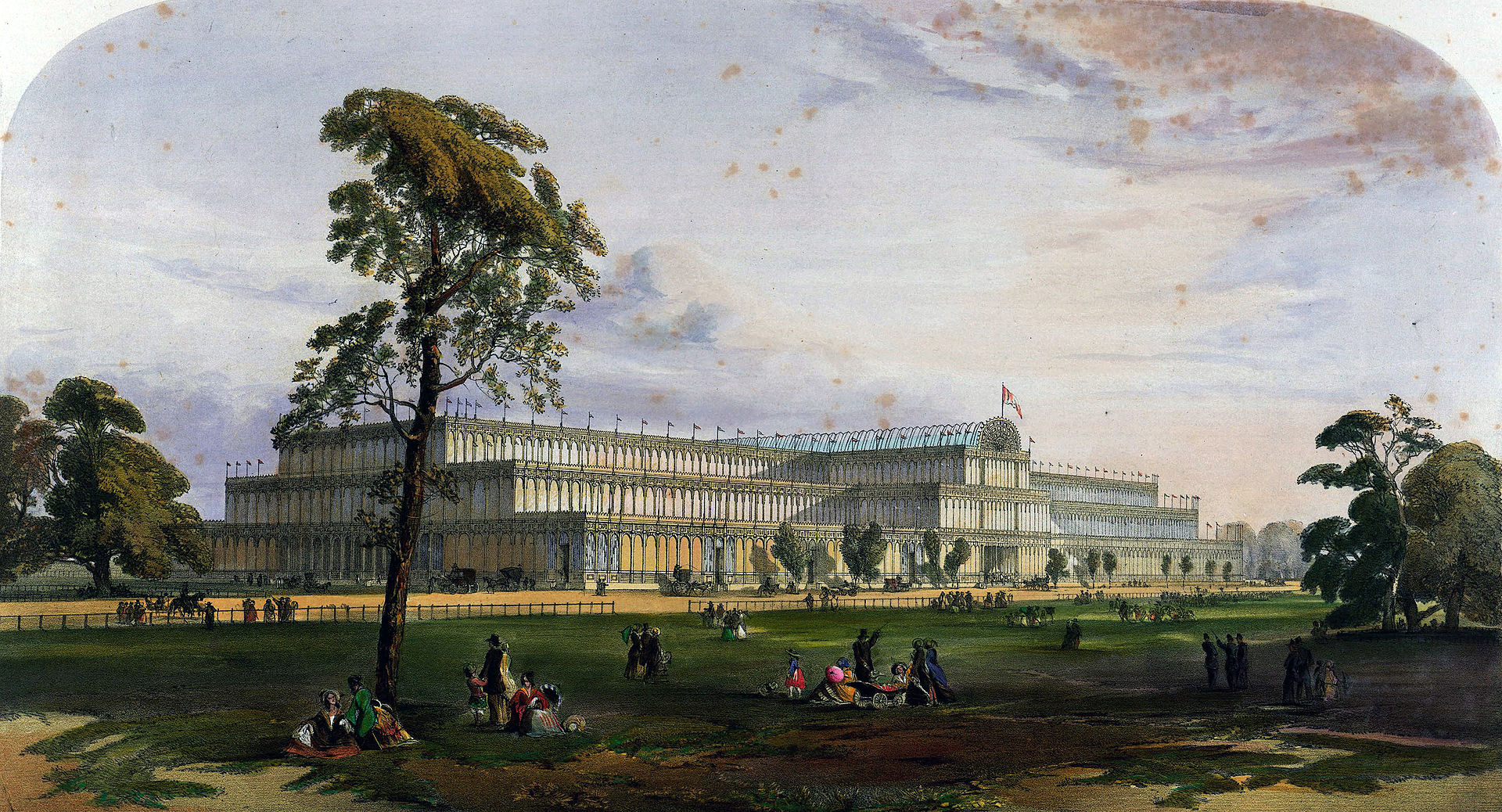
Enter Joseph Paxton, a former gardener whose experience building greenhouses had given him radical ideas about architecture and engineering. Paxton’s design for the Exhibition building was so innovative that it took the architectural establishment completely by surprise. Instead of massive stone walls and traditional construction, he proposed a building made almost entirely of iron and glass – essentially a gigantic greenhouse that would cover 19 acres of Hyde Park.
The Crystal Palace, as it came to be known, was a masterpiece of prefabricated construction that anticipated modern building techniques by half a century. The entire structure was designed as a kit of standardized parts that could be mass-produced and assembled on site, allowing the largest building in the world to be completed in just eight months. It was like constructing a cathedral using the principles of a children’s toy set, but on a scale that boggled contemporary minds.
The building process itself became a London attraction. Thousands of spectators gathered daily to watch the Crystal Palace rise from the ground like some fantastic crystal flower blooming in the heart of Hyde Park. The iron framework went up with mechanical precision, while sheets of glass created walls that seemed to dissolve the boundary between interior and exterior space. Even the ancient elm trees in the construction area were incorporated into the design rather than being cut down, creating an indoor forest that symbolized the harmony between nature and industry.
When the Exhibition opened on May 1, 1851, with Queen Victoria presiding over ceremonies that combined royal pageantry with industrial celebration, London found itself hosting the largest gathering of international visitors in human history. Over six million people would eventually visit the Exhibition – roughly a third of Britain’s entire population – creating logistical challenges that pushed the city’s infrastructure to its limits.
The exhibits themselves were a wonderland of Victorian ingenuity and imperial ambition. Visitors could examine the latest steam engines, marvel at precision machinery, study exotic goods from distant colonies, and gaze upon artistic treasures from around the world. The British sections naturally dominated, showcasing everything from locomotive engines to fine textiles, while international exhibits demonstrated that other nations were making their own contributions to human progress, even if they clearly had some catching up to do.
The Exhibition’s impact on London was immediate and transformative. Hotels, restaurants, and transportation systems strained to accommodate the flood of visitors from across Britain and around the world. The city discovered that it could handle massive events that would have overwhelmed other capitals, establishing London’s reputation as a place capable of organizing spectacular displays of international cooperation and commercial ambition.
But the cultural impact was even more significant. The Great Exhibition established the template for world’s fairs that continues to this day, proving that international exhibitions could serve both commercial and diplomatic purposes. It demonstrated that industrial products could be as worthy of aesthetic appreciation as traditional art, helping to break down barriers between technology and culture that had previously seemed insurmountable.
The financial success was equally remarkable. The Exhibition turned a substantial profit, generating funds that were used to establish the Victoria and Albert Museum, the Science Museum, and the Natural History Museum. South Kensington, previously an underdeveloped area on London’s periphery, became the world’s first dedicated museum district, creating an intellectual and cultural center that enhanced London’s global reputation for learning and scholarship.
Perhaps most importantly, the Great Exhibition marked Britain’s moment of maximum confidence in its industrial and imperial destiny. The country that had invented the steam engine, pioneered railway construction, and created the world’s largest empire was showing off its achievements to a global audience that could only marvel at British technical and commercial superiority.
The Crystal Palace itself, dismantled and rebuilt in South London after the Exhibition closed, became a symbol of Victorian innovation and ambition. Its revolutionary design influenced architecture for generations, while its successful construction proved that iron and glass could create spaces as magnificent as traditional stone and timber buildings.
The Great Exhibition of 1851 established London as the unofficial capital of the modern world, the place where nations came to display their finest achievements and learn about the latest developments in technology, industry, and culture. It was Britain’s moment of supreme confidence, when the nation looked at its accomplishments and decided that what the world really needed was a proper demonstration of how things should be done. For six months, London was the center of the universe, and everyone else was invited to come admire the view.
A Little Bit of London In Your Inbox Weekly. Sign-up for our free weekly London newsletter. Sent every Friday with the latest news from London!