


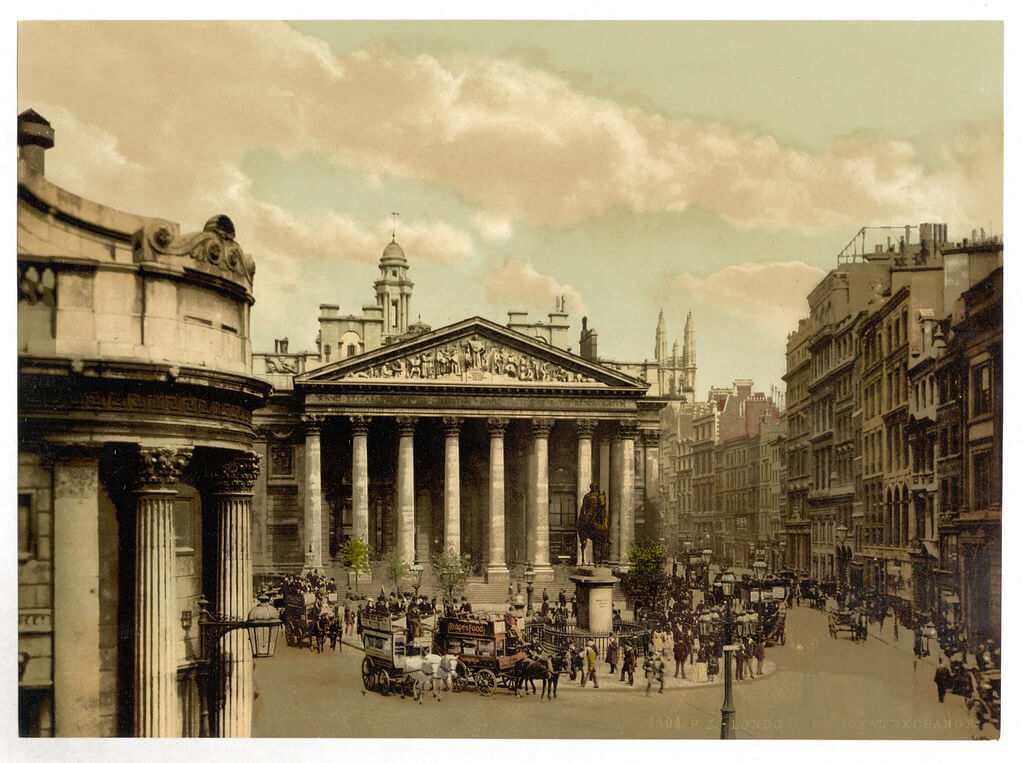


Imagine if someone told you they were going to build a shopping mall, stock exchange, and international business center all rolled into one magnificent building, and then convinced the Queen to give it her personal stamp of approval. That’s essentially what Sir Thomas Gresham pulled off in 1571 when he opened the Royal Exchange, transforming London from a muddy medieval backwater into the beating heart of global commerce.
Before Gresham’s grand vision became reality, London’s merchants conducted their business in the most undignified way possible – standing around in the street like medieval street vendors, getting rained on, snowed on, and generally looking like they were running a very expensive car boot sale. They gathered on Lombard Street, huddling under whatever shelter they could find, making deals that would shape international trade while trying not to slip in the mud or get trampled by passing horses.
This was hardly the image of sophistication that London wanted to project to the world. Venice had its magnificent Rialto, Antwerp boasted its spectacular Bourse, and here was London’s business elite conducting affairs that would make or break empires while dodging puddles and horse droppings. Something had to be done, and Sir Thomas Gresham was just the man to do it.
Gresham was the Tudor era’s answer to a venture capitalist crossed with an international spy. As the Crown’s financial agent in Antwerp, he’d seen how proper Europeans conducted business, and he was determined to bring that level of class to London. Born into a family of merchants, he understood both the romance and the ruthlessness of international trade. More importantly, he had the connections, the vision, and the sheer bloody-minded determination to make his dream a reality.
The project began in 1566 when Gresham purchased a plot of land between Cornhill and Threadneedle Street – prime real estate even then, right in the heart of what would become the City of London. But this wasn’t just about building a fancy building; this was about revolutionizing how business was done in England. Gresham envisioned a space where merchants could meet in comfort and style, where different trades could have their own designated areas, and where the very architecture would announce to the world that London meant business.
The design was revolutionary for its time. Imagine a rectangular courtyard surrounded by covered walkways, with shops and offices on multiple levels. The ground floor was divided into different sections for different types of merchants – spice traders here, cloth dealers there, goldsmiths over there. It was like an early version of a modern shopping center, but instead of selling consumer goods to housewives, it was facilitating international trade deals that would reshape the global economy.
The building itself was a masterpiece of Tudor architecture meets international commerce. The covered walkways meant that merchants could conduct business regardless of London’s notoriously unpredictable weather. The central courtyard provided a grand space for major announcements and ceremonial occasions. And the shops that lined the galleries ensured that the Exchange would be financially self-sustaining – a brilliant piece of early urban planning that would make modern developers weep with envy.
When Queen Elizabeth I officially opened the Royal Exchange on January 23, 1571, she didn’t just cut a ribbon and make a few polite remarks. She toured the entire building, examined the shops, met with merchants, and then – in a stroke of marketing genius that would make modern PR executives bow down in worship – she proclaimed it “Royal” and commanded that it be called the Royal Exchange forever after. Talk about getting the ultimate celebrity endorsement.
The impact was immediate and transformative. Within months, the Royal Exchange had become the epicenter of London’s commercial life. Merchants who had previously conducted business in the rain were now making deals in elegant surroundings that rivaled anything in Europe. Foreign traders began flocking to London, drawn by the promise of a sophisticated business environment that could compete with the great commercial centers of the continent.
But the Royal Exchange was more than just a pretty building with good weather protection. It represented a fundamental shift in how London saw itself. No longer was this just another English market town; this was a city with global ambitions. The Exchange became a symbol of England’s growing confidence as a maritime and commercial power, a physical manifestation of the country’s determination to compete with Spain, Portugal, Venice, and the other established trading empires.
The building also served as an informal news center, where merchants gathered not just to trade goods but to exchange information. Long before newspapers became common, the Royal Exchange was where Londoners went to learn about wars, political developments, and economic trends from around the world. It was Twitter, LinkedIn, and the Financial Times all rolled into one magnificent Tudor-era package.
Perhaps most importantly, the Royal Exchange established London’s reputation as a city where innovation and tradition could coexist. Gresham had created something entirely new while respecting established customs and hierarchies. The result was a space that felt both revolutionary and reassuringly English, a combination that would become a hallmark of London’s approach to business for centuries to come.
The Royal Exchange didn’t just change how London did business – it changed how the world saw London, transforming a medieval city into a modern commercial powerhouse that would eventually rule the waves and reshape the global economy.
A Little Bit of London In Your Inbox Weekly. Sign-up for our free weekly London newsletter. Sent every Friday with the latest news from London!