


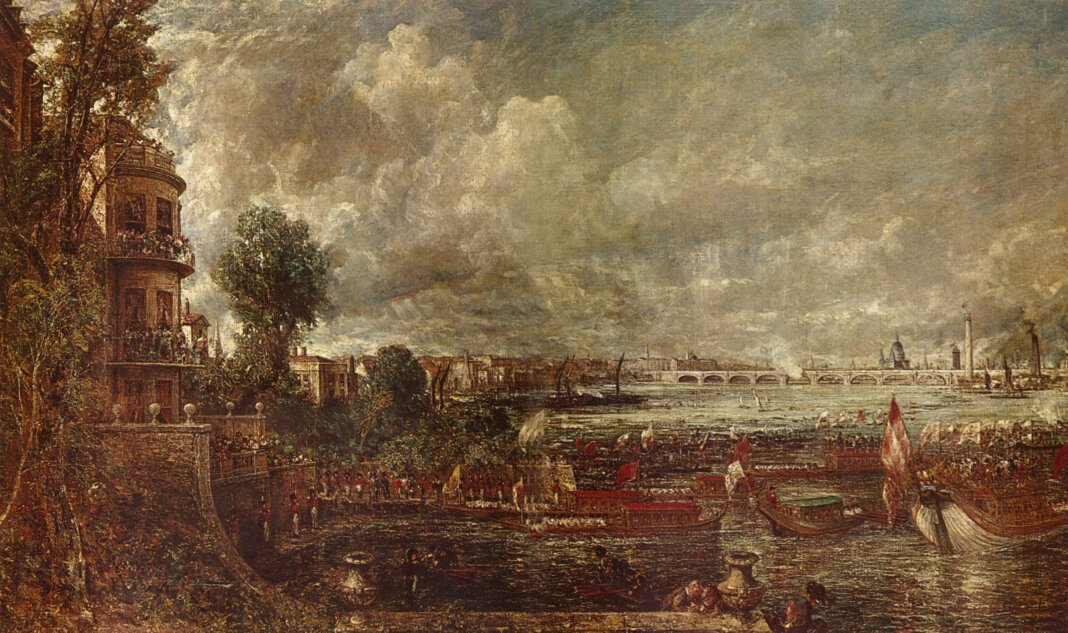


June 18, 1818, was the day London discovered that when it comes to building bridges, women could handle the job just as well as men – possibly better, and definitely with less complaining about the working conditions. The opening of Waterloo Bridge wasn’t just a triumph of engineering; it was a quiet revolution in employment practices that earned the span its affectionate nickname as the “Ladies’ Bridge,” proving that the fairer sex could master the decidedly unfair art of heavy construction.
The bridge’s origins lay in the practical problem of getting from one side of the Thames to the other without either drowning, paying extortionate ferry fees, or taking a lengthy detour to London Bridge. The Strand Bridge Company, formed in 1809, had ambitious plans to create a magnificent crossing that would connect the fashionable West End with the developing South Bank, opening up new possibilities for London’s relentless expansion.
The project faced the usual collection of obstacles that plague major infrastructure developments: political opposition, financial difficulties, engineering challenges, and the general British tendency to treat any change to the status quo as a personal affront to the natural order. The original design by George Dodd was rejected as too expensive, leading to a competition that was eventually won by John Rennie, whose proposal combined practical engineering with aesthetic ambition.
But Rennie’s design, while architecturally magnificent, presented construction challenges that would have daunted lesser cities. The bridge required nine arches spanning 1,242 feet, each built from solid granite quarried in Scotland and transported to London by sea. The engineering tolerances were incredibly tight for the era, requiring precision that pushed contemporary building techniques to their limits.
This is where the story takes its remarkable turn. As construction progressed during the war years, London’s traditional workforce of skilled laborers was increasingly unavailable, either fighting Napoleon or engaged in other war-related industries. The shortage of male workers created an unprecedented opportunity for women to enter the construction trades, and hundreds of them seized the chance with enthusiasm that surprised everyone, including themselves.
The women who built Waterloo Bridge weren’t dilettantes playing at construction work – they were skilled laborers who mastered every aspect of bridge building from mixing mortar to positioning massive granite blocks. They worked alongside the remaining male construction workers as equals, earning the same wages and performing the same tasks. Contemporary accounts describe them as strong, capable, and remarkably proficient at work that had traditionally been considered exclusively masculine.
The sight of women in work clothes hauling granite blocks and operating construction equipment became one of London’s most talked-about spectacles. Fashionable ladies would promenade along the construction site to observe their working-class sisters engaged in this unprecedented occupation. The bridge works became a kind of social laboratory where traditional gender roles were quietly being rewritten with hammers and chisels.
The engineering challenges were formidable regardless of who was doing the work. Each pier had to be constructed in cofferdam – essentially building underwater by pumping out the Thames and working in the riverbed. The granite blocks, some weighing several tons, had to be precisely positioned using primitive cranes and an enormous amount of human muscle power. Every arch required mathematical precision that allowed no margin for error.
The bridge’s design was as much about making a statement as solving a transportation problem. Rennie created a structure that combined classical proportions with functional elegance, featuring Doric columns and decorative elements that proclaimed London’s confidence in its engineering capabilities. This wasn’t just a way to cross the river – it was a monument to British technical achievement and aesthetic ambition.
Construction took nine years, partly because of the technical challenges and partly because of the need to work around Thames tides, river traffic, and the general chaos of building a major structure in the middle of a working waterway. The women workers became a permanent feature of London life during these years, challenging assumptions about female capabilities and opening discussions about women’s roles in society that wouldn’t be fully resolved for another century.
The bridge’s opening ceremony on June 18, 1818 – the third anniversary of the Battle of Waterloo, hence the name – was a magnificent celebration of both engineering achievement and British military victory. The Prince Regent presided over festivities that included military bands, artillery salutes, and a procession of dignitaries who crossed the new bridge with appropriate pomp and ceremony.
But the real celebration belonged to the women who had built it. Contemporary accounts describe how the female construction workers were specifically honored during the opening ceremonies, receiving recognition for their crucial role in completing the project. It was an unprecedented acknowledgment of women’s contribution to a major public work, marking a small but significant step toward gender equality in the workplace.
The bridge immediately became one of London’s most popular attractions. Its wide footpaths and elegant design made it a favorite destination for leisurely walks, while its strategic location connected previously isolated parts of the city. The South Bank, which had been largely undeveloped agricultural land, suddenly became accessible to residents of fashionable Westminster and the West End.
Waterloo Bridge also demonstrated London’s growing mastery of large-scale engineering projects. The precision of its construction, the elegance of its design, and the efficiency of its completion established British engineering credentials that would be crucial as the nation entered the railway age. The bridge became a symbol of what British technical expertise could accomplish when properly organized and funded.
The “Ladies’ Bridge” nickname stuck long after the women workers had moved on to other employment. It served as a reminder of an extraordinary moment when necessity had trumped convention, allowing women to demonstrate capabilities that society had previously denied them. The bridge became not just a crossing point for the Thames, but a symbol of how war and social disruption could sometimes open unexpected opportunities for social change.
Waterloo Bridge stood as a testament to both engineering excellence and social innovation until its replacement in the 1940s, proving that sometimes the most lasting monuments are built not just with stone and steel, but with the courage to challenge conventional wisdom about who can do what when the situation demands it.
A Little Bit of London In Your Inbox Weekly. Sign-up for our free weekly London newsletter. Sent every Friday with the latest news from London!