


June 2-9, 1780, was when London discovered that religious tolerance and mob rule don’t mix well. What began as a peaceful Protestant petition against Catholic relief laws transformed into the worst civil disorder in the city’s history, turning the capital into a battlefield where ancient prejudices, political frustration, and sheer criminal opportunism combined to create a week of chaos that would haunt London’s memory for generations.
The trouble started with Lord George Gordon, a Scottish nobleman whose relationship with political moderation was roughly equivalent to a cat’s relationship with swimming. Gordon had appointed himself champion of Protestant Britain’s opposition to the Catholic Relief Act of 1778, which had granted Catholics some basic civil rights for the first time in over a century. To Gordon and his followers, this wasn’t progress – it was betrayal of everything that made Britain Protestant, free, and gloriously superior to Catholic nations like France and Spain.
The Catholic Relief Act itself was actually quite modest by modern standards. It allowed Catholics to own land, inherit property, and join the army without having to take oaths denouncing their faith. These were hardly revolutionary concessions, but in the fevered imagination of 18th-century Protestant extremists, they represented the thin end of a papist wedge that would somehow result in the Pope ruling Britain from the Vatican while Spanish armies marched up the Thames.
Gordon’s Protestant Association had been organizing opposition to Catholic relief with the kind of passionate intensity usually reserved for religious revivals or football matches. Their petition to Parliament, demanding repeal of the Catholic Relief Act, gathered over 100,000 signatures – an impressive show of popular sentiment in an age when most people couldn’t write their own names, let alone sign political petitions.
The plan for June 2, 1780, seemed reasonable enough: a peaceful march to Parliament to present the petition, with participants wearing blue cockades to identify themselves as loyal Protestants. Gordon envisioned a dignified demonstration that would showcase Protestant unity and convince Parliament to reverse its misguided tolerance. What he got instead was a masterclass in how quickly political demonstrations can spiral into anarchic violence.
The march began peacefully enough, with thousands of Londoners converging on Palace Yard carrying banners proclaiming “No Popery” and singing Protestant hymns. But the crowd’s mood darkened when they encountered Catholics, or people they assumed were Catholics, or people who simply looked like they might possibly know a Catholic. What had started as a religious procession began to resemble a witch hunt conducted by an angry mob with serious impulse control issues.
The situation deteriorated rapidly when the crowd surrounded the Houses of Parliament, trapping members inside and demanding immediate repeal of the Catholic Relief Act. Lords and Commons found themselves prisoners of the very people they claimed to represent, while Gordon, who had lost control of his followers hours earlier, wandered through the chaos like a man who’d accidentally started an avalanche by throwing a pebble.
But the real violence began when the mob turned their attention from political protest to religious persecution. Catholic chapels became targets for destruction, with crowds systematically dismantling buildings that had served London’s Catholic community for years. The Sardinian Chapel in Lincoln’s Inn Fields was reduced to rubble, while the Bavarian Chapel in Warwick Street suffered a similar fate. It was urban renewal by mob violence, with religious bigotry providing the justification.
The riots reached their terrifying peak when the crowds discovered that Newgate Prison housed several Catholics who had been arrested for various offenses. The mob’s solution was characteristically direct: they burned down the prison, releasing hundreds of inmates in the process. The sight of Newgate in flames became the iconic image of the Gordon Riots, symbolizing how quickly civilized society could descend into primitive chaos.
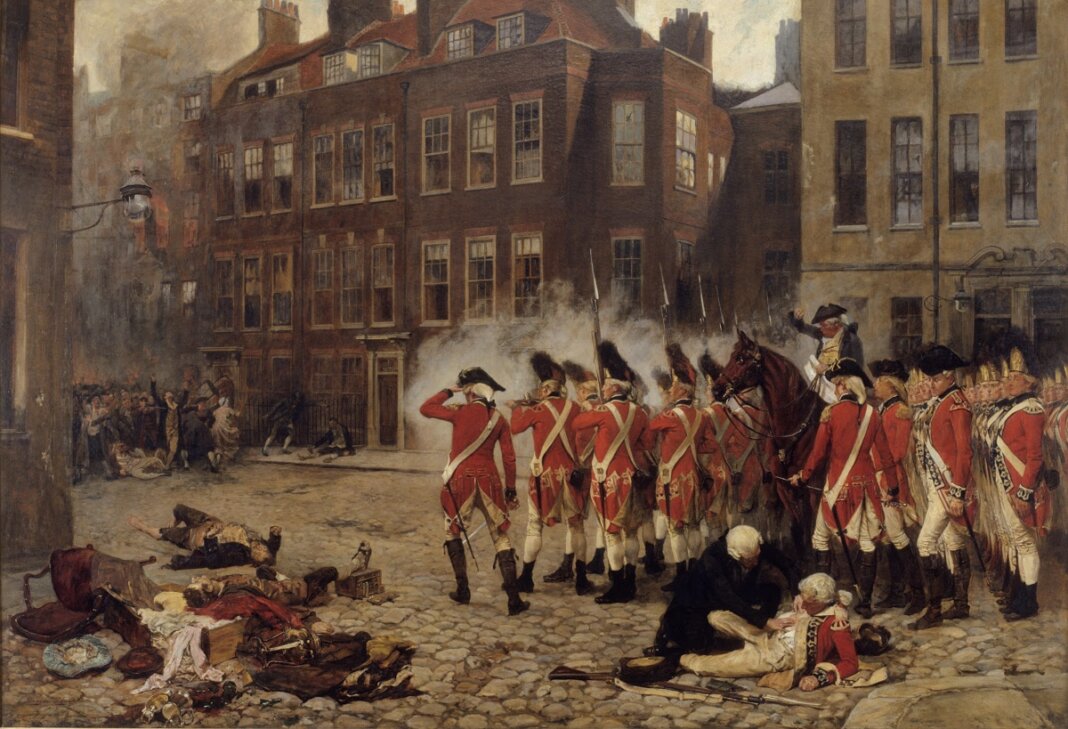
What followed was a week of anarchy that transformed London into something resembling a war zone. Distilleries were attacked and their contents consumed or distributed free to anyone with a container, creating crowds of drunk, angry people with grievances against authority and nothing left to lose. The Bank of England came under attack, forcing its defenders to shoot into the crowd. Mansions belonging to prominent Catholics or Catholic sympathizers were systematically destroyed, their contents burned in the streets.
The government’s response was initially paralyzed by legal uncertainties about using military force against British citizens. The Riot Act existed, but reading it to hostile crowds required a level of courage that few magistrates possessed when faced with thousands of drunk, angry Londoners wielding clubs and torches. It took days for authorities to realize that legal niceties were less important than preventing the complete destruction of the capital.
When the army finally intervened with decisive force, the results were swift and bloody. Soldiers fired volleys into crowds that had grown accustomed to operating with impunity, killing over 200 people and wounding hundreds more. The death toll exceeded that of many proper battles, making the Gordon Riots one of the deadliest episodes of civil disorder in British history.
The aftermath was equally dramatic. Lord Gordon was arrested for high treason, though he was eventually acquitted by a jury that apparently decided that stupidity and fanaticism weren’t quite the same thing as treasonous intent. Hundreds of rioters were arrested, with many facing execution for their roles in the violence. The government’s response sent a clear message that religious tolerance, once granted, would be defended with lethal force if necessary.
The riots also exposed the fragility of civil order in Georgian London. A city that prided itself on its commercial prosperity and political stability had been brought to its knees by a week of mob violence rooted in religious prejudice. The events of June 1780 forced Londoners to confront uncomfortable truths about the persistence of bigotry and the thin line between political expression and criminal chaos.
Perhaps most significantly, the Gordon Riots marked a turning point in British attitudes toward religious tolerance. The violence and destruction convinced many moderate Protestants that anti-Catholic extremism posed a greater threat to social order than Catholic civil rights. The riots ultimately strengthened support for religious tolerance by demonstrating the dangers of religious fanaticism, making London a more inclusive city through the bitter lessons of a week when tolerance temporarily lost to terror.
A Little Bit of London In Your Inbox Weekly. Sign-up for our free weekly London newsletter. Sent every Friday with the latest news from London!