


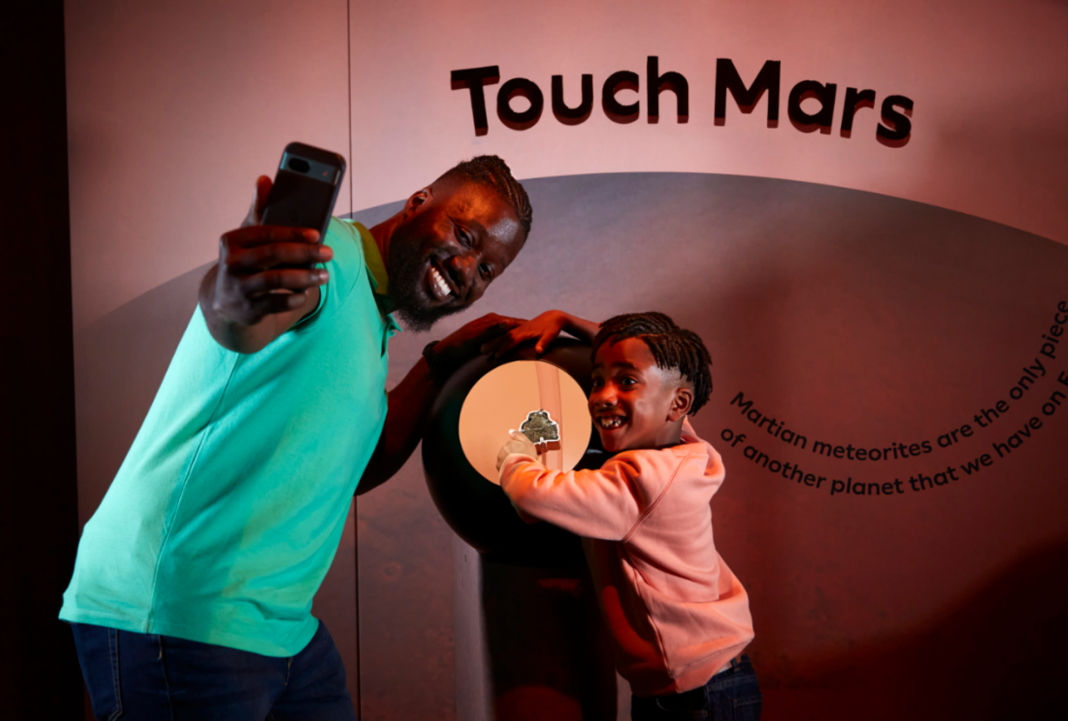


London’s Natural History Museum is ready to take visitors on an interstellar journey with its groundbreaking new exhibition opening today. “Space: Could Life Exist Beyond Earth?” represents the museum’s first major exhibition dedicated entirely to space exploration, offering Londoners and tourists alike a rare opportunity to touch authentic lunar material, hold a piece of Mars, and explore humanity’s most profound question: are we alone in the universe?
A Cosmic Adventure in South Kensington
Opening May 16th and running until February 22nd, 2026, this immersive exhibition brings together cutting-edge science, rare celestial artifacts, and interactive experiences designed to engage visitors of all ages. The exhibition leverages the museum’s significant involvement in international space missions and features more than 60 extraordinary objects, many displayed publicly for the first time.
Professor Caroline Smith, lead scientist on the exhibition, explains the universal appeal: “Space exploration has captured our imagination since humans walked the Earth. From cave art to Buzz Lightyear, the mystery of what lies beyond Earth is too tantalising to ignore – and today there is more evidence than ever before that life could exist beyond Earth.”
The exhibition’s timing coincides with exciting developments in space exploration, including recent findings from asteroid Bennu that made international headlines earlier this year. Museum scientists participated in this groundbreaking research, discovering evidence suggesting asteroids like Bennu and Ryugu likely delivered the first water to Earth – a crucial development in understanding how life might emerge elsewhere in our solar system.
Touch the Cosmos
What sets this exhibition apart is its emphasis on tactile experiences. Visitors can physically handle meteorites billions of years old, including authentic pieces of Mars and the Moon. The exhibition also features a model of the ExoMars Rosalind Franklin rover, scheduled to launch in 2027, which will drill deeper into the Martian surface than any previous mission.
For those who’ve ever wondered what space smells like, specially designed scent pods created by fragrance designer and space scientist Marina Barcenilla offer an olfactory dimension to the cosmic experience. Interactive games throughout the exhibition help explain the essential ingredients for life, making complex scientific concepts accessible to visitors of all ages.
London’s Scientists at the Forefront
The exhibition highlights the crucial role that London-based scientists play in international space exploration efforts. The Natural History Museum’s team works directly with space agencies worldwide, analyzing samples returned from space missions in their South Kensington laboratories.
Visitors can see fragments of asteroid Ryugu brought back from space and learn about the Museum’s contributions to space missions, including scientific instruments for the upcoming ExoMars rover mission.
One particularly intriguing display features the SETI (Search for Extraterrestrial Intelligence) device, part of a global network searching “all the sky, all the time” for signals from technologically advanced civilizations elsewhere in the universe.
A Perspective on Earth’s Uniqueness
While the exhibition focuses on the potential for extraterrestrial life, it also emphasizes the extraordinary conditions that make Earth such a perfect habitat. Museum Director Dr. Doug Gurr notes: “With every mission sent into space we are reminded that here on Earth we have a very precise and complex set of conditions that has led to biodiversity so abundant it’s estimated that we know of less than one quarter of species in the natural world.”
This perspective on Earth’s uniqueness aligns with the Museum’s broader mission to create “advocates for the planet” – people who understand and act to preserve our natural world.
Visiting Information
The exhibition runs daily from 10:00 AM to 5:50 PM (last entry 4:30 PM). Tickets are priced at £16.50 for adults and £8.25 for children during peak times, with slightly reduced rates during off-peak periods. Museum members, patrons, and children under four receive free admission.
The exhibition is supported by Lead Funder the Huo Family Foundation and Lead Corporate Sponsor Jupiter Asset Management.
For Londoners looking for a cosmic day out, this exhibition offers a perfect opportunity to explore the wonders of space without leaving Zone 1. Whether you’re a seasoned astronomy enthusiast or simply curious about what lies beyond our atmosphere, “Space: Could Life Exist Beyond Earth?” promises an engaging, thought-provoking experience that brings the cosmos a little closer to home.
The exhibition is part of the Natural History Museum’s ongoing transformation efforts, which aim to place their groundbreaking research at the heart of the visitor experience. With plans to revitalize four existing galleries, open two magnificent new spaces, and welcome an additional million visitors annually, this space exhibition represents just one step in the institution’s evolution as a world-leading scientific research centre and beloved London landmark.
A Little Bit of London In Your Inbox Weekly. Sign-up for our free weekly London newsletter. Sent every Friday with the latest news from London!