


Revolutionary 18th-century artist’s dramatic “candlelight” paintings return to London spotlight
The National Gallery will illuminate one of Britain’s most fascinating yet underappreciated artists this autumn with Wright of Derby: From the Shadows, opening November 7, 2025. This groundbreaking exhibition marks the first time the gallery has dedicated a show to Joseph Wright ‘of Derby’ (1734–1797) and represents a major reassessment of an artist whose work has come to define the spirit of the Enlightenment.
A New Perspective on an Enlightenment Master
For centuries, Wright of Derby has been celebrated primarily as a “painter of light” who captured the optimistic spirit of scientific discovery during the 18th century. However, this exhibition takes a dramatically different approach, revealing Wright as an artist who deliberately explored darkness to engage with profound themes of death, melancholy, morality, and the sublime.
“We’re challenging the conventional view of Wright as simply a figurehead of Enlightenment optimism,” explains a National Gallery spokesperson. “This exhibition shows him as a far more complex artist who used the interplay of light and shadow to explore the deeper, more troubling questions of his era.”
Candlelight Masterpieces Reunited
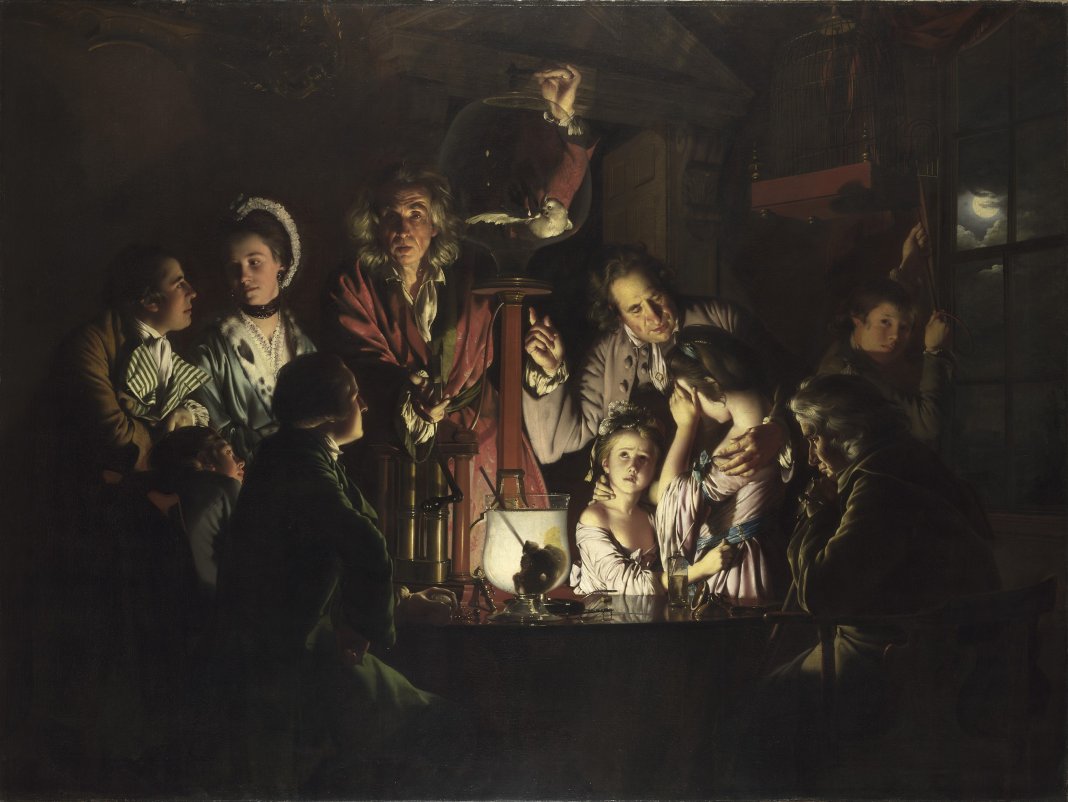
The exhibition focuses on Wright’s most productive and innovative period between 1765 and 1773, when he created his famous series of candlelit scenes. For the first time in 35 years, visitors will be able to see his trilogy of masterpieces together: Three Persons Viewing the Gladiator by Candlelight (1765), A Philosopher giving that Lecture on the Orrery in Which a Lamp is Put in Place of the Sun (1766), and the National Gallery’s own An Experiment on a Bird in the Air Pump (1768).
Also making a rare UK appearance is An Academy by Lamplight (1769) from Yale Center for British Art, which hasn’t been displayed in Britain for over a decade.
Science, Art, and Moral Ambiguity
Wright’s paintings capture thrilling moments of scientific demonstration and artistic contemplation, but they’re far from simple celebrations of discovery. In An Experiment on a Bird in the Air Pump, a travelling lecturer demonstrates the effects of vacuum pressure to a family audience whose reactions range from fascination to horror – a young girl turns away in distress while others lean forward in wonder.
The Orrery depicts a philosopher presenting a lecture on astronomy using a clockwork model of the solar system, with an oil lamp standing in for the sun. Meanwhile, Three Persons Viewing the Gladiator by Candlelight shows artists critically examining a drawing of classical sculpture by flickering candlelight.
“These works explore the moral ambiguity inherent in acts of looking and learning,” notes the exhibition’s curatorial team. “Wright was asking profound questions about the ethics of observation and the sometimes troubling pursuit of knowledge.”
Revolutionary Technique Meets Contemporary Relevance
Wright’s dramatic use of artificial light was revolutionary in British art, drawing inspiration from Renaissance masters like Caravaggio while addressing thoroughly contemporary concerns about education, spectacle, and the democratization of knowledge. Working at the dawn of public art exhibitions – The Air Pump was completed the same year the Royal Academy was founded – Wright understood he was creating work for a broad public audience.
The exhibition will also showcase the mezzotint prints that helped establish Wright’s international reputation, demonstrating how he leveraged popular reproduction techniques to expand his influence both domestically and abroad.
Authentic Period Context
To fully immerse visitors in Wright’s world, the National Gallery has secured loans of actual 18th-century scientific instruments from the Whipple Museum of the History of Science at Cambridge, including a period orrery and air pump similar to those depicted in Wright’s paintings.
A Homecoming for Derby’s Most Famous Son
Following its London run through May 10, 2026, the exhibition will travel to Derby Museum and Art Gallery, bringing Wright’s masterpieces home for the first time in 80 years. Derby Museums holds the world’s largest collection of Wright’s work, with seventeen pieces contributing to the National Gallery exhibition.
“This represents a historic homecoming,” says a Derby Museums representative. “These paintings were born in Derby, and it’s extraordinary that they’re finally returning after eight decades.”
Essential Information
Wright of Derby: From the Shadows runs from November 7, 2025, to May 10, 2026, in the National Gallery’s Sunley Room. The exhibition includes over twenty works exploring both Wright’s artistic practice and the scientific context in which he worked.
Tickets are required for this special exhibition, though the National Gallery’s permanent collection remains free to visit. The show is supported by The Thompson Family Charitable Trust, with the Sunley Room programme supported by the Bernard Sunley Foundation.
For London’s culture enthusiasts, this represents a rare opportunity to encounter one of Britain’s most innovative artists in a completely new light – or perhaps more accurately, emerging from the shadows where his true genius has long resided.
More information and booking at nationalgallery.org.uk
A Little Bit of London In Your Inbox Weekly. Sign-up for our free weekly London newsletter. Sent every Friday with the latest news from London!