


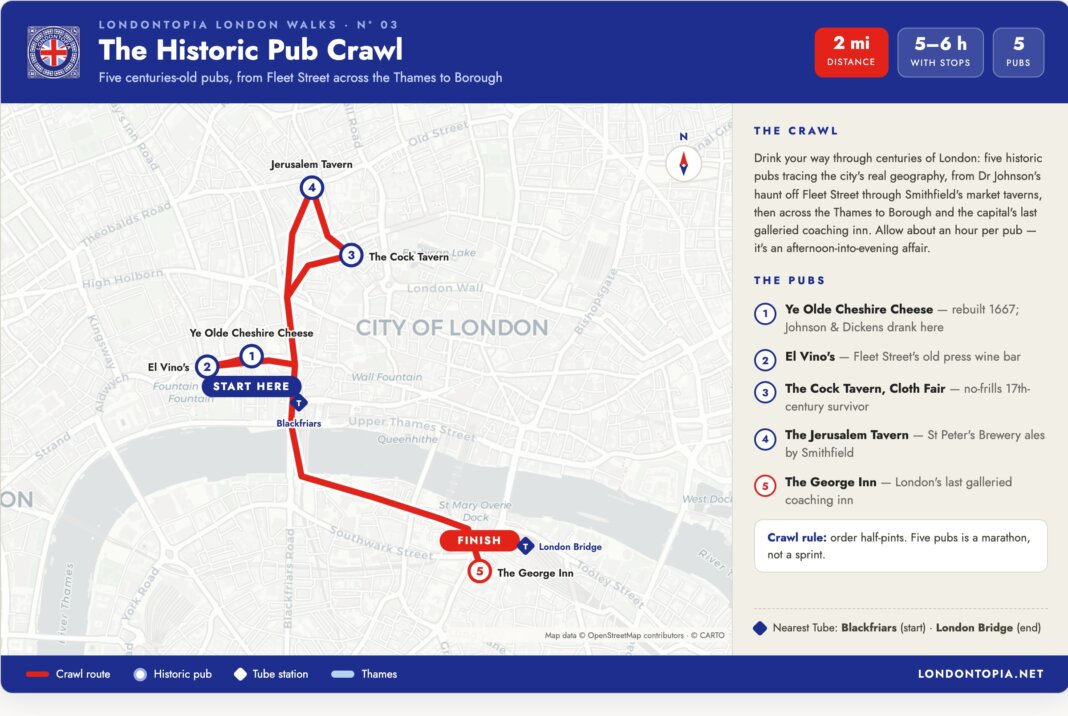
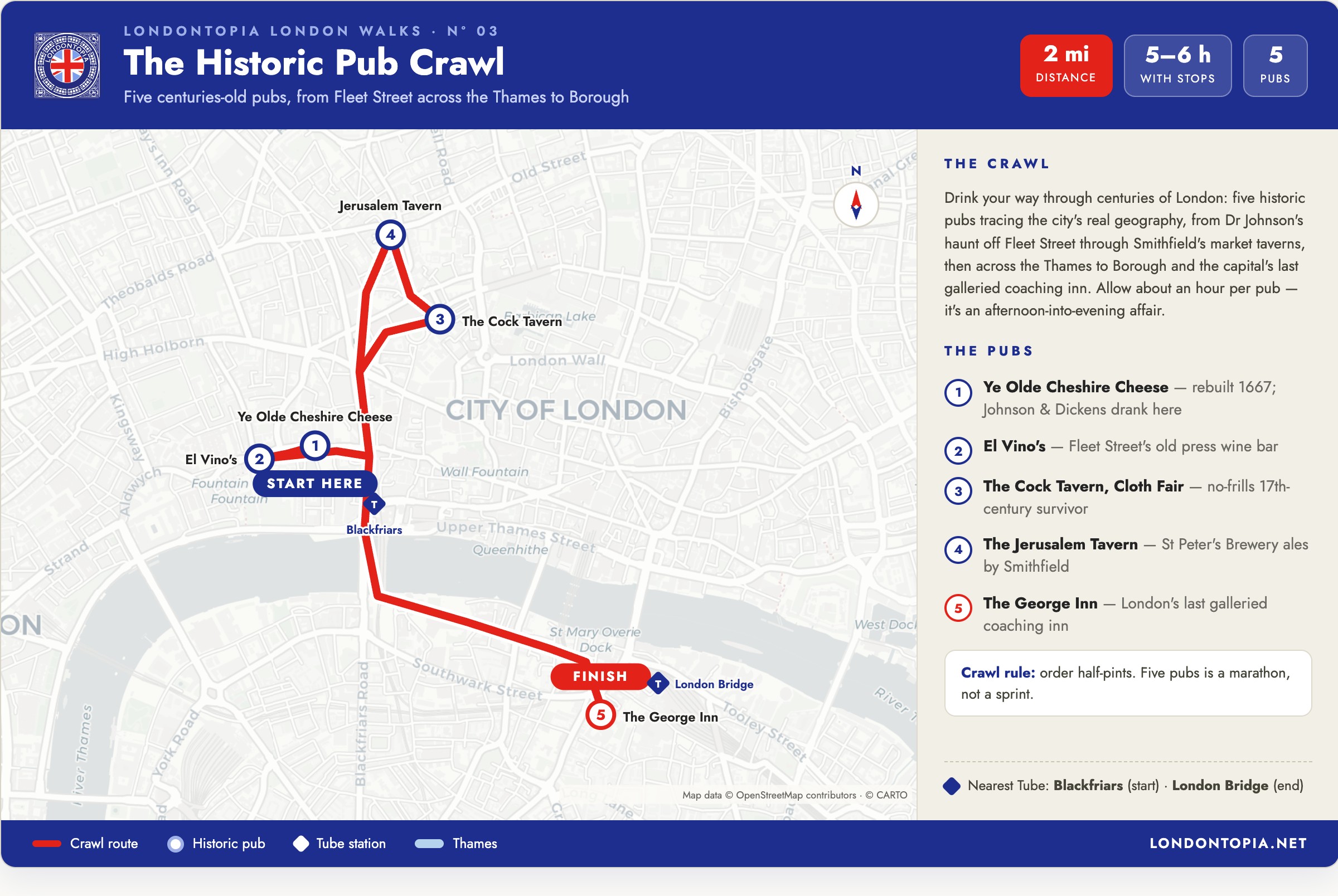
Take this walk with you: download our free, printable PDF map of the route to keep in your pocket — no phone signal required. Download the printable map (PDF) →
London’s pubs are among the city’s most distinctive institutions, places where history, culture, and community intersect over generations. Walking a historic pub crawl—visiting a series of old establishments, learning their stories, enjoying their particular characters—is one of the best ways to experience authentic London and understand the city through the eyes of Londoners. Unlike visiting museums or monuments, pub crawling is something ordinary Londoners do, making it a genuinely local experience.
We’ll map out a route taking you through five significant historic pubs in central London, each with its own character and story. Plan to spend roughly an hour at each location, so the entire crawl takes about five to six hours—very doable as an afternoon and evening activity. The route is loosely circular through the City and surrounding areas, making it easy to navigate.
Start at Ye Olde Cheshire Cheese, located down a narrow alley off Fleet Street. This pub, rebuilt after the Great Fire of 1666 and remaining largely unchanged since then, is one of London’s most famous historic establishments. The pub is extraordinarily atmospheric—low ceilings, wooden panelling, small intimate rooms—creating a sense of stepping back several centuries. The pub was frequented by Samuel Johnson, Charles Dickens, and numerous other historical figures. Walking through its crowded, intimate spaces, you experience something genuinely old and genuine. Order a half-pint (which is a reasonable quantity for a long crawl) and sit in one of the characterful rooms, observing the other patrons and absorbing the atmosphere.
From Ye Olde Cheshire Cheese, walk east along Fleet Street toward the City. Fleet Street was historically the center of London’s newspaper industry, and various pubs along this route were frequented by journalists and writers. El Vino’s, located on Fleet Street, is a wine bar rather than a traditional pub but represents another layer of Fleet Street culture. The bar retains a somewhat dated, old-fashioned character that feels authentically historical.
Continue east to Cloth Fair and locate the Cock Tavern, another historic establishment with genuine antiquity. The Cock Tavern has existed in various locations since the 17th century and retains a authentic character despite various renovations. The pub’s simplicity and no-frills character is part of its appeal—this is what pubs actually are in their essence: places to drink, to socialise, to be part of a community.
From Cloth Fair, walk toward the Smithfield area and locate the Smithfield Market area itself. The Jerusalem Tavern, housed in a Georgian building and selling the beer of the St Peter’s Brewery, is located near Smithfield Market. Smithfield is London’s historic meat market, and the pubs in the area reflect the market’s working-class character. The Jerusalem Tavern’s location near the market means it attracts the market’s workers, giving it an authentically local character. The pub’s interior is small and intimate, and the conversation of working Londoners gives it genuine vitality.
From the Smithfield area, walk south toward the Thames and cross over. Walk toward Borough Market and locate The George Inn, one of London’s few remaining galleried coaching inns. The George Inn, with its characteristic galleries running along one side of an open courtyard, represents a particular type of historic London inn. Dating from the 17th century (though rebuilt after the Great Fire), the George Inn represents transport and travel in the pre-railway era when coaches carried passengers and goods. Sitting in the courtyard or in one of the galleries, you can imagine this place in its historical context—a nexus of travel, commerce, and human connection.
The advantage of this particular pub crawl route is that it traces London’s geography and history simultaneously. You move through the medieval City, along the historic Fleet Street corridor, through the Smithfield Market area (one of London’s oldest markets), across the Thames to the historic Borough area. The pubs you visit aren’t just establishments that happen to be old; they’re nodes in the actual geography of old London, places where important aspects of London’s life historically occurred.
Practical notes: start early enough that your final pub visit is reasonable (not 11 PM if you want to be functioning for dinner). A half-pint at each location is a reasonable quantity—it allows you to experience the pub and its drink without becoming incapacitated. Many of these historic pubs serve food, so you can have a light meal at one or more locations. London pubs are generally warm and welcoming to visitors, so don’t be shy about sitting down and ordering a drink.
What you’ll notice as you move through these pubs is how genuinely British the experience is. The quiet conversation, the lack of loud background music, the sense of the pub as a place for genuine socialising rather than entertainment spectacle—all of this is distinctly British. American bars tend to be louder, more focused on entertainment, more commercialised. British pubs, particularly traditional ones, maintain a sense of being genuinely local spaces where people come to drink and talk.
You’ll also notice the extraordinary variety of beers available in London pubs. British beer culture is complex, with various styles (ales, bitters, milds, IPAs) and numerous breweries represented. Trying different beers at different pubs is part of the pleasure of the crawl. Don’t be afraid to ask the bartender for recommendations—pub staff are generally knowledgeable and happy to talk about their beers.
For visitors interested in understanding London through the experiences of ordinary Londoners, the pub crawl is genuinely valuable. Pubs are where Londoners gather, where work is discussed, where friendships are maintained, where community is built. The historic pubs in particular represent centuries of this social function. By visiting them, you’re not just seeing historical sites; you’re participating (to a limited extent) in an ongoing social function that’s been happening for centuries.
The pub crawl also offers flexibility. If you find a particular pub that you especially like, you can stay longer. If you’re tired, you can end the crawl early. If you discover other historic pubs not on this route, you can visit them. The pleasure of the pub crawl is in the wandering, the discovery, the experience of London neighborhood by neighborhood, stopping for drinks and conversation along the way.
Finally, remember the British convention of the half-pint. Ordering a full pint at each location would lead to excessive alcohol consumption and would mean you’d be unable to function. A half-pint allows you to taste the beer and experience the pub without becoming incapacitated. Many pubs will cheerfully pour half-pints, and this is a completely normal British approach to pub visiting.
The historic pub crawl is one of the most authentically London experiences available to visitors—not something tourists are supposed to do, but something actual Londoners do regularly. By participating in this activity, you’re experiencing London as a Londoner might, understanding the city’s social fabric and historical geography through the lens of its most distinctive social institutions.


Free London Weekly Newsletter
A Little Bit of London In Your Inbox Weekly. Sign-up for our free weekly London newsletter. Sent every Friday with the latest news from London!